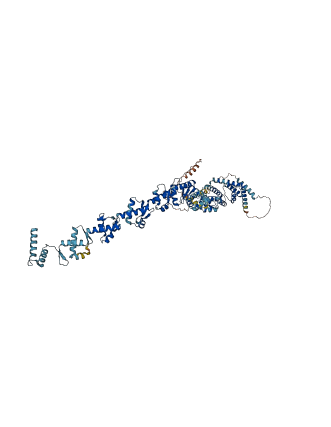
Descriptions
The autoinhibited protein was predicted that may have potential autoinhibitory elements via cis-regPred.
Autoinhibitory domains (AIDs)
Target domain |
|
Relief mechanism |
|
Assay |
cis-regPred |
Accessory elements
No accessory elements
Autoinhibited structure

Activated structure
1 structures for A7S2N8
| Entry ID | Method | Resolution | Chain | Position | Source |
|---|---|---|---|---|---|
| AF-A7S2N8-F1 | Predicted | AlphaFoldDB |
No variants for A7S2N8
| Variant ID(s) | Position | Change | Description | Diseaes Association | Provenance |
|---|---|---|---|---|---|
| No variants for A7S2N8 | |||||
No associated diseases with A7S2N8
No regional properties for A7S2N8
| Type | Name | Position | InterPro Accession |
|---|---|---|---|
| No domain, repeats, and functional sites for A7S2N8 | |||
1 GO annotations of cellular component
| Name | Definition |
|---|---|
| endoplasmic reticulum membrane | The lipid bilayer surrounding the endoplasmic reticulum. |
2 GO annotations of molecular function
| Name | Definition |
|---|---|
| UFM1 ligase activity | Catalysis of the transfer of UFM1 to a substrate protein via the reaction X-UFM1 + S --> X + S-UFM1, where X is either an E2 or E3 enzyme, the X-UFM1 linkage is a thioester bond, and the S-UFM1 linkage is an isopeptide bond between the C-terminal amino acid of UFM1 and the epsilon-amino group of lysine residues in the substrate. |
| UFM1 transferase activity | Catalysis of the transfer of UFM1 from one protein to another via the reaction X-UFM1 + Y --> Y-UFM1 + X, where both X-UFM1 and Y-UFM1 are covalent linkages. |
3 GO annotations of biological process
| Name | Definition |
|---|---|
| protein K69-linked ufmylation | A protein ufmylation process in which a polymer of the ubiquitin-like protein UFM1 is formed by linkages between lysine residues at position 69 of the UFM1 monomers, is added to a protein. |
| regulation of proteasomal ubiquitin-dependent protein catabolic process | Any process that modulates the frequency, rate or extent of the breakdown of a protein or peptide by hydrolysis of its peptide bonds, initiated by the covalent attachment of ubiquitin, and mediated by the proteasome. |
| response to endoplasmic reticulum stress | Any process that results in a change in state or activity of a cell (in terms of movement, secretion, enzyme production, gene expression, etc.) as a result of a stress acting at the endoplasmic reticulum. ER stress usually results from the accumulation of unfolded or misfolded proteins in the ER lumen. |
No homologous proteins in AiPD
| UniProt AC | Gene Name | Protein Name | Species | Evidence Code |
|---|---|---|---|---|
| No homologous proteins | ||||
| 10 | 20 | 30 | 40 | 50 | 60 |
| MADWDEIKKL | AADFHRVQLT | STAHKLSERN | CIEIVQKLIN | TGLLEVIYTT | DGKEYLTPQQ |
| 70 | 80 | 90 | 100 | 110 | 120 |
| LEREIKDELF | VHGGRFFLLN | LVDLQQIINV | DLSHVDNKVS | EILRHDKSLV | LIQGDLIDKD |
| 130 | 140 | 150 | 160 | 170 | 180 |
| YLDRMAEEIN | ETLQEAGQVF | IAELSKTFSL | PTDFMLEVVE | SRLDIQIMGK | LDQMDRNVLY |
| 190 | 200 | 210 | 220 | 230 | 240 |
| THAFIARQTA | RMRGVLSAIT | RPTQFSNIIS | KYGFQEKLFY | SVIGDLLSSK | RIMGSTQGRQ |
| 250 | 260 | 270 | 280 | 290 | 300 |
| DKISFVPDVY | TQAQNNWVDD | FFKQNGYVEY | DALTRLGITD | GKQFLKRRYH | GNEIFLPTCC |
| 310 | 320 | 330 | 340 | 350 | 360 |
| VGERVLDQAD | AAIDDALSSG | TWVDIMPHLP | TPFTPDDAEQ | LLQHCLKTPG | RSTAHVYCSS |
| 370 | 380 | 390 | 400 | 410 | 420 |
| IVASDKFVEA | CKAPFETRMH | AKAKKDAAES | PALFAELSKK | DLASLKGGGG | GADRREARKE |
| 430 | 440 | 450 | 460 | 470 | 480 |
| DRRKTASSGG | KGGGSVGGRG | GRETKTKKVK | KKDFRNRNDE | DDTNEADSRS | NPDELQFMTT |
| 490 | 500 | 510 | 520 | 530 | 540 |
| EEIAEVLRKD | RPDIDDDFLE | ELAQEMHRPL | TRAYQQVARA | VLQSSGDKKR | KSHAEIQEKV |
| 550 | 560 | 570 | 580 | 590 | 600 |
| NALWANAKLF | DKSINLFPED | VQVHLSRHLL | RTVCTDITNL | MVNMLAADHM | LAVTDETTIT |
| 610 | 620 | 630 | 640 | 650 | 660 |
| PETRLKIIKK | MPEEIKAPLT | KLNSSLTAKE | TEEFFAQFDL | VAGQGLCELM | IKKLDKKKER |
| 670 | 680 | 690 | 700 | 710 | 720 |
| QISIERRAAL | QEQLRHEDEP | AMTLHLAVSL | LFQHFTSSLL | HAPGRCVPQI | VALLAEHVTP |
| 730 | 740 | 750 | 760 | 770 | 780 |
| EQHEILLRCQ | SLVVKQLTRS | GSDEVEEEAG | DEHENEAGVE | KSTAVLLEEG | MREIKKMVLE |
| LKKDNSKNES |