A7RIT9
Gene name |
v1g178517 |
Protein name |
3-hydroxyanthranilate 3,4-dioxygenase |
Names |
3-hydroxyanthranilate oxygenase, 3-HAO, 3-hydroxyanthranilic acid dioxygenase, HAD |
Species |
Nematostella vectensis (Starlet sea anemone) |
KEGG Pathway |
nve:5520803 |
EC number |
1.13.11.6: With incorporation of two atoms of oxygen |
Protein Class |
|
Descriptions
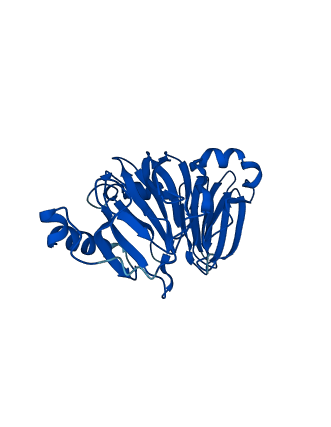
The autoinhibited protein was predicted that may have potential autoinhibitory elements via cis-regPred.
Autoinhibitory domains (AIDs)
Target domain |
|
Relief mechanism |
|
Assay |
cis-regPred |
Accessory elements
No accessory elements
Autoinhibited structure

Activated structure
1 structures for A7RIT9
| Entry ID | Method | Resolution | Chain | Position | Source |
|---|---|---|---|---|---|
| AF-A7RIT9-F1 | Predicted | AlphaFoldDB |
No variants for A7RIT9
| Variant ID(s) | Position | Change | Description | Diseaes Association | Provenance |
|---|---|---|---|---|---|
| No variants for A7RIT9 | |||||
No associated diseases with A7RIT9
No regional properties for A7RIT9
| Type | Name | Position | InterPro Accession |
|---|---|---|---|
| No domain, repeats, and functional sites for A7RIT9 | |||
Functions
| Description | ||
|---|---|---|
| EC Number | 1.13.11.6 | With incorporation of two atoms of oxygen |
| Subcellular Localization |
|
|
| PANTHER Family | ||
| PANTHER Subfamily | ||
| PANTHER Protein Class | ||
| PANTHER Pathway Category | No pathway information available | |
1 GO annotations of cellular component
| Name | Definition |
|---|---|
| cytoplasm | The contents of a cell excluding the plasma membrane and nucleus, but including other subcellular structures. |
2 GO annotations of molecular function
| Name | Definition |
|---|---|
| 3-hydroxyanthranilate 3,4-dioxygenase activity | Catalysis of the reaction: 3-hydroxyanthranilate + O(2) = cis,cis-2-amino-3-(3-oxoprop-1-enyl)but-2-enedioate + H(+). |
| ferrous iron binding | Binding to a ferrous iron ion, Fe(II). |
5 GO annotations of biological process
| Name | Definition |
|---|---|
| 'de novo' NAD biosynthetic process from tryptophan | The chemical reactions and pathways resulting in the formation of nicotinamide adenine dinucleotide (NAD), beginning with the synthesis of tryptophan from simpler precursors; biosynthesis may be of either the oxidized form, NAD, or the reduced form, NADH. |
| anthranilate metabolic process | The chemical reactions and pathways involving anthranilate (2-aminobenzoate). |
| quinolinate biosynthetic process | The chemical reactions and pathways resulting in the formation of quinolinate, the anion of quinolinic acid, also known as 2,3-pyridinedicarboxylic acid. |
| quinolinate metabolic process | The chemical reactions and pathways involving quinolinate, the anion of quinolinic acid, also known as 2,3-pyridinedicarboxylic acid. |
| tryptophan catabolic process | The chemical reactions and pathways resulting in the breakdown of tryptophan, the chiral amino acid 2-amino-3-(1H-indol-3-yl)propanoic acid. |
No homologous proteins in AiPD
| UniProt AC | Gene Name | Protein Name | Species | Evidence Code |
|---|---|---|---|---|
| No homologous proteins | ||||
| 10 | 20 | 30 | 40 | 50 | 60 |
| MMEWIDENSS | LFVPPVCNKL | MYGEGQLKIM | FVGGPNTRKD | YHLEEGEELF | FQVKGDMCLK |
| 70 | 80 | 90 | 100 | 110 | 120 |
| VLEKGKPKDI | IIKEGEMFLL | PSRFNHSPQR | FENTVGLVIE | RERLPEEIDG | LRYFCEDGVT |
| 130 | 140 | 150 | 160 | 170 | 180 |
| VLWEKFFHCT | DLTQIAPVIK | EFFESEEHKT | GKPSKESSCS | INVDTETELM | EPFPLKQWLK |
| 190 | 200 | 210 | 220 | 230 | 240 |
| DNKDSYRSGS | MAIFEKGEFK | VHAHGSGEQE | GHSQGEMWFW | QLEGKATVNV | DEITRELNKN |
| 250 | 260 | 270 | |||
| DVLMITAGSD | FRVKREEGSV | GLSITVDSLA | NK |