A7EJG6
Gene name |
atg5 (SS1G_05459) |
Protein name |
Autophagy protein 5 |
Names |
|
Species |
Sclerotinia sclerotiorum (strain ATCC 18683 / 1980 / Ss-1) (White mold) (Whetzelinia sclerotiorum) |
KEGG Pathway |
ssl:SS1G_05459 |
EC number |
|
Protein Class |
|
Descriptions
The autoinhibited protein was predicted that may have potential autoinhibitory elements via cis-regPred.
Autoinhibitory domains (AIDs)
Target domain |
|
Relief mechanism |
|
Assay |
cis-regPred |
Accessory elements
No accessory elements
Autoinhibited structure

Activated structure
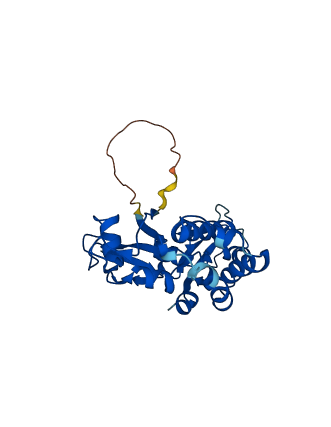
1 structures for A7EJG6
| Entry ID | Method | Resolution | Chain | Position | Source |
|---|---|---|---|---|---|
| AF-A7EJG6-F1 | Predicted | AlphaFoldDB |
No variants for A7EJG6
| Variant ID(s) | Position | Change | Description | Diseaes Association | Provenance |
|---|---|---|---|---|---|
| No variants for A7EJG6 | |||||
No associated diseases with A7EJG6
No regional properties for A7EJG6
| Type | Name | Position | InterPro Accession |
|---|---|---|---|
| No domain, repeats, and functional sites for A7EJG6 | |||
2 GO annotations of cellular component
| Name | Definition |
|---|---|
| Atg12-Atg5-Atg16 complex | A protein complex required for the expansion of the autophagosomal membrane. In budding yeast, this complex consists of Atg12p, Atg5p and Atg16p. |
| phagophore assembly site membrane | A cellular membrane associated with the phagophore assembly site. |
No GO annotations of molecular function
| Name | Definition |
|---|---|
| No GO annotations for molecular function |
6 GO annotations of biological process
| Name | Definition |
|---|---|
| autophagosome assembly | The formation of a double membrane-bounded structure, the autophagosome, that occurs when a specialized membrane sac, called the isolation membrane, starts to enclose a portion of the cytoplasm. |
| autophagy of mitochondrion | The autophagic process in which mitochondria are delivered to a type of vacuole and degraded in response to changing cellular conditions. |
| autophagy of nucleus | A form of autophagy, by which damaged or non-essential parts of the nucleus, or even an entire nucleus is degraded. |
| C-terminal protein lipidation | The covalent attachment of a lipid group to the carboxy-terminus of a protein. |
| cellular response to nitrogen starvation | Any process that results in a change in state or activity of a cell (in terms of movement, secretion, enzyme production, gene expression, etc.) as a result of deprivation of nitrogen. |
| protein transport | The directed movement of proteins into, out of or within a cell, or between cells, by means of some agent such as a transporter or pore. |
No homologous proteins in AiPD
| UniProt AC | Gene Name | Protein Name | Species | Evidence Code |
|---|---|---|---|---|
| No homologous proteins | ||||
| 10 | 20 | 30 | 40 | 50 | 60 |
| MQSLIWASAI | PLYITHSSST | IPYLINVPRV | SYLALLFPRL | TSFFGENVSS | FSYEGILLKN |
| 70 | 80 | 90 | 100 | 110 | 120 |
| LPVGLLCDLY | QPELPWRIEL | GDGPLFDIHD | TFINSVKEAD | FMRNGNAKGI | MSMSKEHSTQ |
| 130 | 140 | 150 | 160 | 170 | 180 |
| LWNSVQDNDF | STYHKISTIL | LNPATALKHI | PLRIYLPSSS | TPSSTPHPGS | SGSSKAPSTA |
| 190 | 200 | 210 | 220 | 230 | 240 |
| SPPSPLFTFK | TIQTLIQPQT | TSREPQTLGG | ALNSVLPTLF | PSKRDAILAE | VILHGATVPF |
| 250 | 260 | ||||
| KAVLEDLMRE | ASYADGWLNV | CVVMLN |