A6ZN26
Descriptions
The autoinhibited protein was predicted that may have potential autoinhibitory elements via cis-regPred.
Autoinhibitory domains (AIDs)
Target domain |
|
Relief mechanism |
|
Assay |
cis-regPred |
Accessory elements
No accessory elements
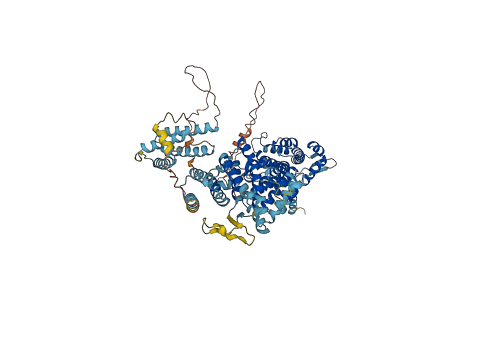
Autoinhibited structure

Activated structure
1 structures for A6ZN26
| Entry ID | Method | Resolution | Chain | Position | Source |
|---|---|---|---|---|---|
| AF-A6ZN26-F1 | Predicted | AlphaFoldDB |
No variants for A6ZN26
| Variant ID(s) | Position | Change | Description | Diseaes Association | Provenance |
|---|---|---|---|---|---|
| No variants for A6ZN26 | |||||
No associated diseases with A6ZN26
3 GO annotations of cellular component
| Name | Definition |
|---|---|
| eukaryotic 43S preinitiation complex | A protein complex composed of the 40S ribosomal subunit plus eIF1A, eIF3, and eIF2-GTP-bound methionyl-initiator methionine tRNA. |
| eukaryotic 48S preinitiation complex | A protein complex composed of the small ribosomal subunit, eIF3, eIF1A, methionyl-initiatior methionine and a capped mRNA. The complex is initially positioned at the 5'-end of the capped mRNA. |
| eukaryotic translation initiation factor 3 complex | A complex of several polypeptides that plays at least two important roles in protein synthesis: First, eIF3 binds to the 40S ribosome and facilitates loading of the Met-tRNA/eIF2.GTP ternary complex to form the 43S preinitiation complex. Subsequently, eIF3 apparently assists eIF4 in recruiting mRNAs to the 43S complex. The eIF3 complex contains five conserved core subunits, and may contain several additional proteins; the non-core subunits are thought to mediate association of the complex with specific sets of mRNAs. |
3 GO annotations of molecular function
| Name | Definition |
|---|---|
| RNA binding | Binding to an RNA molecule or a portion thereof. |
| translation initiation factor activity | Functions in the initiation of ribosome-mediated translation of mRNA into a polypeptide. |
| translation initiation factor binding | Binding to a translation initiation factor, any polypeptide factor involved in the initiation of ribosome-mediated translation. |
1 GO annotations of biological process
| Name | Definition |
|---|---|
| formation of cytoplasmic translation initiation complex | Joining of the large subunit, with release of IF2/eIF2 and IF3/eIF3. This leaves the functional ribosome at the AUG, with the methionyl/formyl-methionyl-tRNA positioned at the P site. |
No homologous proteins in AiPD
| UniProt AC | Gene Name | Protein Name | Species | Evidence Code |
|---|---|---|---|---|
| No homologous proteins | ||||
| 10 | 20 | 30 | 40 | 50 | 60 |
| MSRFFSSNYE | YDVASSSSEE | DLLSSSEEDL | LSSSSSESEL | DQESDDSFFN | ESESESEADV |
| 70 | 80 | 90 | 100 | 110 | 120 |
| DSDDSDAKPY | GPDWFKKSEF | RKQGGGSNKF | LKSSNYDSSD | EESDEEDGKK | VVKSAKEKLL |
| 130 | 140 | 150 | 160 | 170 | 180 |
| DEMQDVYNKI | SQAENSDDWL | TISNEFDLIS | RLLVRAQQQN | WGTPNIFIKV | VAQVEDAVNN |
| 190 | 200 | 210 | 220 | 230 | 240 |
| TQQADLKNKA | VARAYNTTKQ | RVKKVSRENE | DSMAKFRNDP | ESFDKEPTAD | LDISANGFTI |
| 250 | 260 | 270 | 280 | 290 | 300 |
| SSSQGNDQAV | QEDFFTRLQT | IIDSRGKKTV | NQQSLISTLE | ELLTVAEKPY | EFIMAYLTLI |
| 310 | 320 | 330 | 340 | 350 | 360 |
| PSRFDASANL | SYQPIDQWKS | SFNDISKLLS | ILDQTIDTYQ | VNEFADPIDF | IEDEPKEDSD |
| 370 | 380 | 390 | 400 | 410 | 420 |
| GVKRILGSIF | SFVERLDDEF | MKSLLNIDPH | SSDYLIRLRD | EQSIYNLILR | TQLYFEATLK |
| 430 | 440 | 450 | 460 | 470 | 480 |
| DEHDLERALT | RPFVKRLDHI | YYKSENLIKI | METAAWNIIP | AQYKSKFTSK | DQLDSADYVD |
| 490 | 500 | 510 | 520 | 530 | 540 |
| NLIDGLSTIL | SKQNNIAVQK | RAILYNIYYT | ALNKDFQTAK | DMLLTSQVQT | NINQFDSSLQ |
| 550 | 560 | 570 | 580 | 590 | 600 |
| ILFNRVVVQL | GLSAFKLCLI | EECHQILNDL | LSSSHLREIL | GQQSLHRISL | NSSNNASADE |
| 610 | 620 | 630 | 640 | 650 | 660 |
| RARQCLPYHQ | HINLDLIDVV | FLTCSLLIEI | PRMTAFYSGI | KVKRIPYSPK | SIRRSLEHYD |
| 670 | 680 | 690 | 700 | 710 | 720 |
| KLSFQGPPET | LRDYVLFAAK | SMQKGNWRDS | VKYLREIKSW | ALLPNMETVL | NSLTERVQVE |
| 730 | 740 | 750 | 760 | 770 | 780 |
| SLKTYFFSFK | RFYSSFSVAK | LAELFDLPEN | KVVEVLQSVI | AELEIPAKLN | DEKTIFVVEK |
| 790 | 800 | 810 | |||
| GDEITKLEEA | MVKLNKEYKI | AKERLNPPSN | RR |