A6YRN9
Gene name |
TP |
Protein name |
Trehalose phosphorylase |
Names |
Trehalose synthase, TSase |
Species |
Pleurotus pulmonarius (Indian oyster mushroom) |
KEGG Pathway |
|
EC number |
2.4.1.231: Hexosyltransferases |
Protein Class |
|
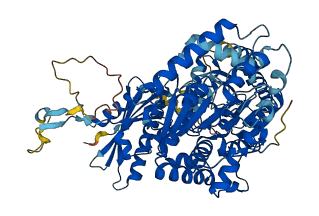
Descriptions
The autoinhibited protein was predicted that may have potential autoinhibitory elements via cis-regPred.
Autoinhibitory domains (AIDs)
Target domain |
|
Relief mechanism |
|
Assay |
cis-regPred |
Accessory elements
No accessory elements
Autoinhibited structure

Activated structure
1 structures for A6YRN9
| Entry ID | Method | Resolution | Chain | Position | Source |
|---|---|---|---|---|---|
| AF-A6YRN9-F1 | Predicted | AlphaFoldDB |
No variants for A6YRN9
| Variant ID(s) | Position | Change | Description | Diseaes Association | Provenance |
|---|---|---|---|---|---|
| No variants for A6YRN9 | |||||
No associated diseases with A6YRN9
1 regional properties for A6YRN9
| Type | Name | Position | InterPro Accession |
|---|---|---|---|
| domain | Glycosyl transferase, family 1 | 499 - 675 | IPR001296 |
Functions
| Description | ||
|---|---|---|
| EC Number | 2.4.1.231 | Hexosyltransferases |
| Subcellular Localization |
|
|
| PANTHER Family | ||
| PANTHER Subfamily | ||
| PANTHER Protein Class | ||
| PANTHER Pathway Category | No pathway information available | |
No GO annotations of cellular component
| Name | Definition |
|---|---|
| No GO annotations for cellular component |
1 GO annotations of molecular function
| Name | Definition |
|---|---|
| alpha,alpha-trehalose phosphorylase (configuration-retaining) activity | Catalysis of the reaction: alpha,alpha-trehalose + phosphate = alpha-D-glucose + alpha-D-glucose 1-phosphate. |
3 GO annotations of biological process
| Name | Definition |
|---|---|
| glucose 6-phosphate metabolic process | The chemical reactions and pathways involving glucose 6-phosphate, a monophosphorylated derivative of glucose with the phosphate group attached to C-6. |
| glucose metabolic process | The chemical reactions and pathways involving glucose, the aldohexose gluco-hexose. D-glucose is dextrorotatory and is sometimes known as dextrose; it is an important source of energy for living organisms and is found free as well as combined in homo- and hetero-oligosaccharides and polysaccharides. |
| trehalose metabolic process | The chemical reactions and pathways involving trehalose, a disaccharide isomeric with sucrose and obtained from certain lichens and fungi. |
No homologous proteins in AiPD
| UniProt AC | Gene Name | Protein Name | Species | Evidence Code |
|---|---|---|---|---|
| No homologous proteins | ||||
| 10 | 20 | 30 | 40 | 50 | 60 |
| MSTPHHQFES | KSSTAIRRRL | SSSVSSKQRP | NIMTTTFASL | TPMWAGVAGT | LVNNNTQYEI |
| 70 | 80 | 90 | 100 | 110 | 120 |
| AVTVHDGVYS | TDFASVIIPV | TPGDTVKNSK | DIEAQVLNLI | RKFSAEHLCK | FLGAGITLAL |
| 130 | 140 | 150 | 160 | 170 | 180 |
| LKECPNLCTR | LWLDMDIVPI | VFNIKPFHTD | SVTRPNIKHR | ISSTTGSYVP | SGSETPTVYV |
| 190 | 200 | 210 | 220 | 230 | 240 |
| EASHLDDPSH | LSPNAAQKLP | IPRTLDEQSD | SAARKCLMYF | GPNNNPRLSI | GARNQVTVDA |
| 250 | 260 | 270 | 280 | 290 | 300 |
| GGKIHLIDDL | EEYRETVGAG | TWNAVIKLAD | ELREKKVKIG | FFSSTPQGGG | VALMRHALIR |
| 310 | 320 | 330 | 340 | 350 | 360 |
| FLTALDVDVA | WYVPNPSPQV | FRTTKNNHNI | LQGVAAPDLR | LTQEAKDAFD | AWILKNGLRW |
| 370 | 380 | 390 | 400 | 410 | 420 |
| TAEGGPLAPG | GVDVVFIDDP | QMPGLIPLIK | KVRPEVPIVY | RSHIEIRSDL | VHVAGSPQEE |
| 430 | 440 | 450 | 460 | 470 | 480 |
| VWKYLWNNIQ | LADLFISHPV | SKFVPSDVPT | EKLALLGAAT | DWLDGLNKDL | DPWDSQFYMG |
| 490 | 500 | 510 | 520 | 530 | 540 |
| EFRSPCAKEK | MHELNWPARD | YIVQVARFDP | SKGIPNVVDS | YYKFRNLLRT | RSPDMDESEH |
| 550 | 560 | 570 | 580 | 590 | 600 |
| PQLLICGHGA | VDDPDASIIY | DQIMALVNSD | PYKEYAHDIV | VMRLPPSDEL | LNAMMANSRI |
| 610 | 620 | 630 | 640 | 650 | 660 |
| ALQLSTREGF | EVKVSEALHT | GKPVIACRTG | GIPLQIQHGK | SGYLTTPGDN | DAVAGHLYDL |
| 670 | 680 | 690 | 700 | 710 | 720 |
| YTDEALYRKM | SDFARTHVSD | EVGTVGNAAA | WLYLAVMYSR | GEKIKPNGAW | INDLLREETG |
| 730 | |||||
| EPYKEGETKL | PRTKLDMQG |