A6VGM3
Gene name |
dnaG |
Protein name |
DNA primase DnaG |
Names |
|
Species |
Methanococcus maripaludis (strain C7 / ATCC BAA-1331) |
KEGG Pathway |
mmz:MmarC7_0531 |
EC number |
2.7.7.101: Nucleotidyltransferases |
Protein Class |
|
Descriptions
The autoinhibited protein was predicted that may have potential autoinhibitory elements via cis-regPred.
Autoinhibitory domains (AIDs)
Target domain |
|
Relief mechanism |
|
Assay |
cis-regPred |
Accessory elements
No accessory elements
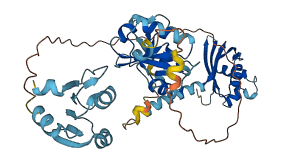
Autoinhibited structure

Activated structure
1 structures for A6VGM3
| Entry ID | Method | Resolution | Chain | Position | Source |
|---|---|---|---|---|---|
| AF-A6VGM3-F1 | Predicted | AlphaFoldDB |
No variants for A6VGM3
| Variant ID(s) | Position | Change | Description | Diseaes Association | Provenance |
|---|---|---|---|---|---|
| No variants for A6VGM3 | |||||
No associated diseases with A6VGM3
6 regional properties for A6VGM3
| Type | Name | Position | InterPro Accession |
|---|---|---|---|
| domain | Polymerase/histidinol phosphatase, N-terminal | 3 - 70 | IPR003141 |
| domain | PHP domain | 4 - 121 | IPR004013 |
| domain | OB-fold nucleic acid binding domain, AA-tRNA synthetase-type | 918 - 983 | IPR004365 |
| domain | Bacterial DNA polymerase III, alpha subunit, NTPase domain | 263 - 501 | IPR011708 |
| domain | DNA polymerase, helix-hairpin-helix motif | 741 - 828 | IPR029460 |
| domain | DNA polymerase III alpha subunit finger domain | 504 - 667 | IPR040982 |
Functions
| Description | ||
|---|---|---|
| EC Number | 2.7.7.101 | Nucleotidyltransferases |
| Subcellular Localization |
|
|
| PANTHER Family | ||
| PANTHER Subfamily | ||
| PANTHER Protein Class | ||
| PANTHER Pathway Category | No pathway information available | |
3 GO annotations of cellular component
| Name | Definition |
|---|---|
| DNA-directed RNA polymerase complex | A protein complex that possesses DNA-directed RNA polymerase activity. |
| exosome (RNase complex) | A ribonuclease complex that has 3-prime to 5-prime exoribonuclease activity and possibly endoribonuclease activity, producing 5-prime-phosphomonoesters. Participates in a multitude of cellular RNA processing and degradation events preventing nuclear export and/or translation of aberrant RNAs. Restricted to processing linear and circular single-stranded RNAs (ssRNA) only. RNAs with complex secondary structures may have to be unwound or pre-processed by co-factors prior to entering the complex, esp if the 3-prime end is structured. |
| primosome complex | Any of a family of protein complexes that form at the origin of replication or stalled replication forks and function in replication primer synthesis in all organisms. Early complexes initiate double-stranded DNA unwinding. The core unit consists of a replicative helicase and a primase. The helicase further unwinds the DNA and recruits the polymerase machinery. The primase synthesizes RNA primers that act as templates for complementary stand replication by the polymerase machinery. The primosome contains a number of associated proteins and protein complexes and contributes to the processes of replication initiation, lagging strand elongation, and replication restart. |
3 GO annotations of molecular function
| Name | Definition |
|---|---|
| DNA primase activity | Catalysis of the synthesis of a short RNA primer on a DNA template, providing a free 3'-OH that can be extended by DNA-directed DNA polymerases. |
| metal ion binding | Binding to a metal ion. |
| poly(A) binding | Binding to a sequence of adenylyl residues in an RNA molecule, such as the poly(A) tail, a sequence of adenylyl residues at the 3' end of eukaryotic mRNA. |
No GO annotations of biological process
| Name | Definition |
|---|---|
| No GO annotations for biological process |
No homologous proteins in AiPD
| UniProt AC | Gene Name | Protein Name | Species | Evidence Code |
|---|---|---|---|---|
| No homologous proteins | ||||
| 10 | 20 | 30 | 40 | 50 | 60 |
| MDLGTTKYII | YTELIADGYV | EKHDVIGAIF | GQTEGLLSNE | LDLRDLQKSG | RIGRIDVDLE |
| 70 | 80 | 90 | 100 | 110 | 120 |
| NINGKSFAKI | TLPSSLDKVE | TSILAATLET | IDRVGPCFAT | VKITEVEDIR | VSKRQYITNR |
| 130 | 140 | 150 | 160 | 170 | 180 |
| ARSILRKLMD | EMIDTYEITE | EIKESLRTEE | IMEFGPENLP | CGPNVVHSDS | IIVVEGRADV |
| 190 | 200 | 210 | 220 | 230 | 240 |
| LTLLRCGIKN | TVAVEGTSVP | KSIMELTKKK | TTTAFTDGDR | GGELILKELL | QTCDIDYVAR |
| 250 | 260 | 270 | 280 | 290 | 300 |
| APYGKEVEGT | SKKEIMKCLR | AKVPVEQIVG | NNCNNSCNVS | EVINSNSPEE | IVESVTPKYF |
| 310 | 320 | 330 | 340 | 350 | 360 |
| EKVETPVTEP | VFDDNVVEEE | TVIVEPVKKT | ETEIIDVDAA | NESQVDKKFS | GVKEIVDSIK |
| 370 | 380 | 390 | 400 | 410 | 420 |
| NTGNVKFVVD | GTEKTNTFKE | FLTNIHEIKK | MDFFAADMPI | SQKIVDLLYD | KTPIIVGKEI |
| 430 | |||||
| NVTKKPVNLR | LFSFDEIVA |