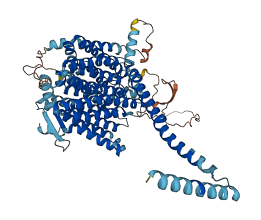
Descriptions
The autoinhibited protein was predicted that may have potential autoinhibitory elements via cis-regPred.
Autoinhibitory domains (AIDs)
Target domain |
|
Relief mechanism |
|
Assay |
cis-regPred |
Accessory elements
No accessory elements
Autoinhibited structure

Activated structure
1 structures for A6H5N8
| Entry ID | Method | Resolution | Chain | Position | Source |
|---|---|---|---|---|---|
| AF-A6H5N8-F1 | Predicted | AlphaFoldDB |
No variants for A6H5N8
| Variant ID(s) | Position | Change | Description | Diseaes Association | Provenance |
|---|---|---|---|---|---|
| No variants for A6H5N8 | |||||
No associated diseases with A6H5N8
3 regional properties for A6H5N8
| Type | Name | Position | InterPro Accession |
|---|---|---|---|
| domain | NADH-Ubiquinone oxidoreductase (complex I), chain 5 N-terminal | 75 - 125 | IPR001516 |
| domain | NADH:quinone oxidoreductase/Mrp antiporter, membrane subunit | 141 - 441 | IPR001750 |
| domain | NADH:ubiquinone/plastoquinone oxidoreductase, chloroplast chain 5, C-terminal | 448 - 684 | IPR002128 |
2 GO annotations of cellular component
| Name | Definition |
|---|---|
| chloroplast thylakoid membrane | The pigmented membrane of a chloroplast thylakoid. An example of this component is found in Arabidopsis thaliana. |
| integral component of membrane | The component of a membrane consisting of the gene products and protein complexes having at least some part of their peptide sequence embedded in the hydrophobic region of the membrane. |
2 GO annotations of molecular function
| Name | Definition |
|---|---|
| NADH dehydrogenase (ubiquinone) activity | Catalysis of the reaction: NADH + ubiquinone + 5 H(+)(in) <=> NAD(+) + ubiquinol + 4 H(+)(out). |
| quinone binding | Binding to a quinone, any member of a class of diketones derivable from aromatic compounds by conversion of two CH groups into CO groups with any necessary rearrangement of double bonds. |
1 GO annotations of biological process
| Name | Definition |
|---|---|
| ATP synthesis coupled electron transport | The transfer of electrons through a series of electron donors and acceptors, generating energy that is ultimately used for synthesis of ATP. |
No homologous proteins in AiPD
| UniProt AC | Gene Name | Protein Name | Species | Evidence Code |
|---|---|---|---|---|
| No homologous proteins | ||||
| 10 | 20 | 30 | 40 | 50 | 60 |
| MELIYKYVWI | VPFLPLSASV | PIGSGSLLFP | RATRGLHHIW | ALISISLLGI | AMLLSFNLFL |
| 70 | 80 | 90 | 100 | 110 | 120 |
| QQITGGPVYQ | YLWSWTINKN | FSPELGYLID | PLTSIMPISV | TTVGIMVMIY | SDNYMSHDQG |
| 130 | 140 | 150 | 160 | 170 | 180 |
| YVRFFAYLSL | FNASMLGLVI | SPNLVQIYIF | WELVGMCSYL | LIGSWFTRPS | AANACQKAFI |
| 190 | 200 | 210 | 220 | 230 | 240 |
| TNRIGDFGLL | LGILGFYQIT | GSFKFRYLLG | RSNESIASNE | VSSFFATLCA | FLLFLGPVAK |
| 250 | 260 | 270 | 280 | 290 | 300 |
| SAQFPLHVWL | PDAMEGPTPI | SALIHAATMV | AAGIFLVARL | FPLFKALPFI | MNLISWTGGI |
| 310 | 320 | 330 | 340 | 350 | 360 |
| TALLGATMAL | AQSDLKRGLA | YSTMSQSGYM | VLALGTGSYR | AALFHPITHA | YSKALLFLGS |
| 370 | 380 | 390 | 400 | 410 | 420 |
| GSVIHSMESL | VGYCPAESQN | MALMGGLSKY | MPITGTTFLL | GTLSLCGIPP | FACFWSKDEI |
| 430 | 440 | 450 | 460 | 470 | 480 |
| ISDSWLYSTI | LGGIARSAAG | FTAFYMSRMY | FLAFEGDLRV | NLYNDPIPFY | SISMWGEKES |
| 490 | 500 | 510 | 520 | 530 | 540 |
| GTFTETEMGS | MPQLPGNKNS | SSSEGVFQFS | GKMEQFDGKP | MEYLVITHPL | DKGDPPYPKE |
| 550 | 560 | 570 | 580 | 590 | 600 |
| SDNTMLLPSL | VLGLFTLFVG | SIGVSFVQGE | ISSDILSQRL | TLSMNHFHEN | HPENWSEFFV |
| 610 | 620 | 630 | 640 | 650 | 660 |
| DAIPSVGIAF | SSTFVAFVLY | GPINFNFSSP | YLWYKRDSRL | KGIPDRFINV | IYNWSYYRGY |
| 670 | 680 | 690 | 700 | 710 | 720 |
| IDIYYNKIFT | MGIRRLAELT | YLFDRWVIDG | IIDRVGILGL | FVGEGMKYLG | GGRTSSYLFG |
| 730 | |||||
| FLFFAVIFLL | TIFIFIWIR |