A5HNF6
Gene name |
MYD88 (RCJMB04_14h3) |
Protein name |
Myeloid differentiation primary response protein MyD88 |
Names |
|
Species |
Gallus gallus (Chicken) |
KEGG Pathway |
gga:420420 |
EC number |
|
Protein Class |
|
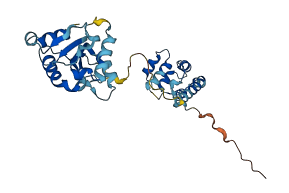
Descriptions
The autoinhibited protein was predicted that may have potential autoinhibitory elements via cis-regPred.
Autoinhibitory domains (AIDs)
Target domain |
|
Relief mechanism |
|
Assay |
cis-regPred |
Accessory elements
No accessory elements
Autoinhibited structure

Activated structure
1 structures for A5HNF6
| Entry ID | Method | Resolution | Chain | Position | Source |
|---|---|---|---|---|---|
| AF-A5HNF6-F1 | Predicted | AlphaFoldDB |
No variants for A5HNF6
| Variant ID(s) | Position | Change | Description | Diseaes Association | Provenance |
|---|---|---|---|---|---|
| No variants for A5HNF6 | |||||
No associated diseases with A5HNF6
4 GO annotations of cellular component
| Name | Definition |
|---|---|
| cytoplasm | The contents of a cell excluding the plasma membrane and nucleus, but including other subcellular structures. |
| cytosol | The part of the cytoplasm that does not contain organelles but which does contain other particulate matter, such as protein complexes. |
| nucleus | A membrane-bounded organelle of eukaryotic cells in which chromosomes are housed and replicated. In most cells, the nucleus contains all of the cell's chromosomes except the organellar chromosomes, and is the site of RNA synthesis and processing. In some species, or in specialized cell types, RNA metabolism or DNA replication may be absent. |
| plasma membrane | The membrane surrounding a cell that separates the cell from its external environment. It consists of a phospholipid bilayer and associated proteins. |
2 GO annotations of molecular function
| Name | Definition |
|---|---|
| TIR domain binding | Binding to a Toll-Interleukin receptor (TIR) domain of a protein. The TIR domain is an intracellular 200 residue domain that is found in the Toll protein, the interleukin-1 receptor (IL-1R), and MyD88; it contains three highly-conserved regions, and mediates protein-protein interactions between the Toll-like receptors (TLRs) and signal-transduction components. |
| Toll-like receptor binding | Binding to a Toll-like protein, a pattern recognition receptor that binds pattern motifs from a variety of microbial sources to initiate an innate immune response. |
8 GO annotations of biological process
| Name | Definition |
|---|---|
| defense response to Gram-positive bacterium | Reactions triggered in response to the presence of a Gram-positive bacterium that act to protect the cell or organism. |
| inflammatory response | The immediate defensive reaction (by vertebrate tissue) to infection or injury caused by chemical or physical agents. The process is characterized by local vasodilation, extravasation of plasma into intercellular spaces and accumulation of white blood cells and macrophages. |
| innate immune response | Innate immune responses are defense responses mediated by germline encoded components that directly recognize components of potential pathogens. |
| MyD88-dependent toll-like receptor signaling pathway | A toll-like receptor signaling pathway in which the MyD88 adaptor molecule mediates transduction of the signal. Toll-like receptors directly bind pattern motifs from a variety of microbial sources to initiate an innate immune response. |
| positive regulation of I-kappaB kinase/NF-kappaB signaling | Any process that activates or increases the frequency, rate or extent of I-kappaB kinase/NF-kappaB signaling. |
| positive regulation of NIK/NF-kappaB signaling | Any process that activates or increases the frequency, rate or extent of NIK/NF-kappaB signaling. |
| Toll signaling pathway | The series of molecular signals initiated by an extracellular ligand binding to the receptor Toll on the surface of a target cell, and ending with the regulation of a downstream cellular process, e.g. transcription. |
| toll-like receptor signaling pathway | The series of molecular signals initiated by a ligand binding to a toll-like receptor on the surface of a target cell. Toll-like receptors directly bind pattern motifs from a variety of microbial sources to initiate an innate immune response. |
No homologous proteins in AiPD
| UniProt AC | Gene Name | Protein Name | Species | Evidence Code |
|---|---|---|---|---|
| No homologous proteins | ||||
| 10 | 20 | 30 | 40 | 50 | 60 |
| MATVPVGAGS | APGPEPADLH | SVPMVALNYG | VRRRLGLYLN | PRAATAADWT | ALAEKLGHDY |
| 70 | 80 | 90 | 100 | 110 | 120 |
| LEIRRLEALP | DPTAALLEEW | QSRCPGGATV | GQLLELLRQL | GRHDVLLELG | GSVEEDCKKY |
| 130 | 140 | 150 | 160 | 170 | 180 |
| LRRKQQEAEQ | PLQVPAVDSS | VPKTSELMGI | TTRDDPYGHG | TEMFDAFICY | CQKDLQFVQE |
| 190 | 200 | 210 | 220 | 230 | 240 |
| MIRELEQTEF | KLKLCVFDRD | VLPGTCVWSI | SGELIERRCR | RMVVVISDDY | LESDECDFQT |
| 250 | 260 | 270 | 280 | 290 | |
| KFALSLSPGA | RLKRLIPVKC | KTMKNEFPSI | LRFITICDYT | NPCTKKWFWT | RLAKSLLLP |