A5GW48
Gene name |
pyrB |
Protein name |
Aspartate carbamoyltransferase |
Names |
Aspartate transcarbamylase, ATCase |
Species |
Synechococcus sp (strain RCC307) |
KEGG Pathway |
syr:SynRCC307_2204 |
EC number |
2.1.3.2: Carboxy- and carbamoyltransferases |
Protein Class |
|
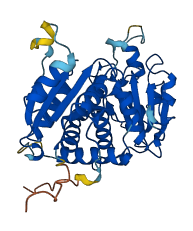
Descriptions
The autoinhibited protein was predicted that may have potential autoinhibitory elements via cis-regPred.
Autoinhibitory domains (AIDs)
Target domain |
|
Relief mechanism |
|
Assay |
cis-regPred |
Accessory elements
No accessory elements
Autoinhibited structure

Activated structure
1 structures for A5GW48
| Entry ID | Method | Resolution | Chain | Position | Source |
|---|---|---|---|---|---|
| AF-A5GW48-F1 | Predicted | AlphaFoldDB |
No variants for A5GW48
| Variant ID(s) | Position | Change | Description | Diseaes Association | Provenance |
|---|---|---|---|---|---|
| No variants for A5GW48 | |||||
No associated diseases with A5GW48
No regional properties for A5GW48
| Type | Name | Position | InterPro Accession |
|---|---|---|---|
| No domain, repeats, and functional sites for A5GW48 | |||
Functions
| Description | ||
|---|---|---|
| EC Number | 2.1.3.2 | Carboxy- and carbamoyltransferases |
| Subcellular Localization |
|
|
| PANTHER Family | ||
| PANTHER Subfamily | ||
| PANTHER Protein Class | ||
| PANTHER Pathway Category | No pathway information available | |
No GO annotations of cellular component
| Name | Definition |
|---|---|
| No GO annotations for cellular component |
2 GO annotations of molecular function
| Name | Definition |
|---|---|
| amino acid binding | Binding to an amino acid, organic acids containing one or more amino substituents. |
| aspartate carbamoyltransferase activity | Catalysis of the reaction: L-aspartate + carbamoyl phosphate = N-carbamoyl-L-aspartate + H(+) + phosphate. |
3 GO annotations of biological process
| Name | Definition |
|---|---|
| 'de novo' pyrimidine nucleobase biosynthetic process | The chemical reactions and pathways resulting in the formation of pyrimidine nucleobases, 1,3-diazine, organic nitrogenous bases, beginning with the synthesis of a pyrimidine ring from simpler precursors. |
| 'de novo' UMP biosynthetic process | The chemical reactions and pathways resulting in the formation of UMP, uridine monophosphate, starting with the synthesis of (S)-dihydroorotate from bicarbonate; UMP biosynthesis may either occur via reduction by quinone, NAD(+) or oxygen. |
| cellular amino acid metabolic process | The chemical reactions and pathways involving amino acids, carboxylic acids containing one or more amino groups, as carried out by individual cells. |
No homologous proteins in AiPD
| UniProt AC | Gene Name | Protein Name | Species | Evidence Code |
|---|---|---|---|---|
| No homologous proteins | ||||
| 10 | 20 | 30 | 40 | 50 | 60 |
| MEVIARPPLS | RWSYRHVLDL | AAFSQEDYAT | VLELASRFRA | LPMSGPRRLP | ALQGRLVTTL |
| 70 | 80 | 90 | 100 | 110 | 120 |
| FFEPSTRTRS | SFELAARRLS | ADVQSFSPAS | SALAKGESLL | DTARTYVAMG | ADVLVVRHRC |
| 130 | 140 | 150 | 160 | 170 | 180 |
| AGVPAELARD | LEAAGCRTAV | LNAGDGLHSH | PSQALLDLFT | LARHFNPETP | TLEALAGKRI |
| 190 | 200 | 210 | 220 | 230 | 240 |
| VIVGDVLHSR | VARSNLWSLT | ACGVDVVLCG | PASLLPDAFA | QFTHAPPPGQ | AQDLVAQRGS |
| 250 | 260 | 270 | 280 | 290 | 300 |
| LRIERDLDRA | LEGADAVMTL | RLQQERMKEQ | LITSLEAYHQ | RYGLSHRRLE | RCGKSVPVLH |
| 310 | 320 | 330 | 340 | 350 | |
| PGPVNRGVEL | SGELLDDPSR | SLVEEQVRNG | IPVRMALLYL | MAASEPASSA | AGLS |