A5DY34
Gene name |
DRS1 (LELG_02271) |
Protein name |
ATP-dependent RNA helicase DRS1 |
Names |
|
Species |
Lodderomyces elongisporus (strain ATCC 11503 / CBS 2605 / JCM 1781 / NBRC 1676 / NRRL YB-4239) (Yeast) (Saccharomyces elongisporus) |
KEGG Pathway |
lel:LELG_02271 |
EC number |
3.6.4.13: Acting on ATP; involved in cellular and subcellular movement |
Protein Class |
|
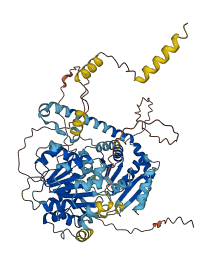
Descriptions
The autoinhibited protein was predicted that may have potential autoinhibitory elements via cis-regPred.
Autoinhibitory domains (AIDs)
Target domain |
|
Relief mechanism |
|
Assay |
cis-regPred |
Accessory elements
No accessory elements
Autoinhibited structure

Activated structure
1 structures for A5DY34
| Entry ID | Method | Resolution | Chain | Position | Source |
|---|---|---|---|---|---|
| AF-A5DY34-F1 | Predicted | AlphaFoldDB |
No variants for A5DY34
| Variant ID(s) | Position | Change | Description | Diseaes Association | Provenance |
|---|---|---|---|---|---|
| No variants for A5DY34 | |||||
No associated diseases with A5DY34
7 regional properties for A5DY34
| Type | Name | Position | InterPro Accession |
|---|---|---|---|
| domain | Dynamin stalk domain | 222 - 490 | IPR000375 |
| domain | Dynamin, GTPase domain | 1 - 301 | IPR001401 |
| domain | Dynamin GTPase effector | 515 - 608 | IPR003130 |
| conserved_site | Dynamin, GTPase region, conserved site | 61 - 70 | IPR019762 |
| domain | GTPase effector domain | 520 - 612 | IPR020850 |
| domain | Dynamin-type guanine nucleotide-binding (G) domain | 32 - 301 | IPR030381 |
| domain | Dynamin, N-terminal | 38 - 213 | IPR045063 |
Functions
| Description | ||
|---|---|---|
| EC Number | 3.6.4.13 | Acting on ATP; involved in cellular and subcellular movement |
| Subcellular Localization |
|
|
| PANTHER Family | ||
| PANTHER Subfamily | ||
| PANTHER Protein Class | ||
| PANTHER Pathway Category | No pathway information available | |
1 GO annotations of cellular component
| Name | Definition |
|---|---|
| nucleolus | A small, dense body one or more of which are present in the nucleus of eukaryotic cells. It is rich in RNA and protein, is not bounded by a limiting membrane, and is not seen during mitosis. Its prime function is the transcription of the nucleolar DNA into 45S ribosomal-precursor RNA, the processing of this RNA into 5.8S, 18S, and 28S components of ribosomal RNA, and the association of these components with 5S RNA and proteins synthesized outside the nucleolus. This association results in the formation of ribonucleoprotein precursors; these pass into the cytoplasm and mature into the 40S and 60S subunits of the ribosome. |
4 GO annotations of molecular function
| Name | Definition |
|---|---|
| ATP binding | Binding to ATP, adenosine 5'-triphosphate, a universally important coenzyme and enzyme regulator. |
| ATP hydrolysis activity | Catalysis of the reaction: ATP + H2O = ADP + H+ phosphate. ATP hydrolysis is used in some reactions as an energy source, for example to catalyze a reaction or drive transport against a concentration gradient. |
| RNA binding | Binding to an RNA molecule or a portion thereof. |
| RNA helicase activity | Unwinding of an RNA helix, driven by ATP hydrolysis. |
1 GO annotations of biological process
| Name | Definition |
|---|---|
| ribosome biogenesis | A cellular process that results in the biosynthesis of constituent macromolecules, assembly, and arrangement of constituent parts of ribosome subunits; includes transport to the sites of protein synthesis. |
No homologous proteins in AiPD
| UniProt AC | Gene Name | Protein Name | Species | Evidence Code |
|---|---|---|---|---|
| No homologous proteins | ||||
| 10 | 20 | 30 | 40 | 50 | 60 |
| MAKNEDLILT | IDSDAEYDNI | SESSEEEAEE | AVSVKSKKKN | NNNNNNKKSK | AGKHGKANLE |
| 70 | 80 | 90 | 100 | 110 | 120 |
| EAEAEEDDDE | ARGEMNLDFQ | FSLGDDLNEI | KDWEVEEPAK | DIDLNEIIKK | KRESKKDGNG |
| 130 | 140 | 150 | 160 | 170 | 180 |
| DDEEDDGDED | EDASESEEDD | EKEELKAAGK | NGQAGDDDED | ENEDEDEEEE | VDTKEDLDNF |
| 190 | 200 | 210 | 220 | 230 | 240 |
| YESQETNTSA | SALKSKTFQE | LQLSRPILKS | LQQLGFTVPT | PVQASTIPIA | LLGKDIVASA |
| 250 | 260 | 270 | 280 | 290 | 300 |
| QTGSGKTAAY | LIPIIERLLY | VKNSTSTKAI | ILTPTRELAI | QVHDVGRKLG | QFVSNLNFGM |
| 310 | 320 | 330 | 340 | 350 | 360 |
| AVGGLSLKQQ | EQQLKTRPDI | VIATPGRLID | HIRNSPSFSV | EDVQVLIIDE | ADRMLEEGFQ |
| 370 | 380 | 390 | 400 | 410 | 420 |
| EELTEILSLI | PKQKRQTLLF | SATMNNTKIQ | DLVQLSLNKP | IKVSIDPPRT | VASKLEQQFV |
| 430 | 440 | 450 | 460 | 470 | 480 |
| RIRKREELKP | AVLYLLLKKL | EGRTVVFTRT | KVEAHKLRII | LGLLGLTVAE | LHGALTQEQR |
| 490 | 500 | 510 | 520 | 530 | 540 |
| LANVKAFKNN | VNVLICTDLA | ARGLDIRIEY | VINYDMPKTY | EIYTHRVGRT | ARAGRKGTSI |
| 550 | 560 | 570 | 580 | 590 | 600 |
| SFVGESMQDR | NIVKNAIQFN | SRSVARKIDW | DEVEKIQTKI | KLNEGAIEEV | IEEEKQAREI |
| 610 | 620 | 630 | 640 | 650 | 660 |
| MRAEMQLNKA | ENLMKYEKEI | KSRPKRTWFK | SEVMEHLTKH | GKKVNAKKRK | ANEERKEEGK |
| 670 | 680 | ||||
| ERSYKKTKAD | RTKLKTKAKS | SSKKRK |