A5DQA8
Gene name |
ATG13 (PGUG_05459) |
Protein name |
Autophagy-related protein 13 |
Names |
|
Species |
Meyerozyma guilliermondii (strain ATCC 6260 / CBS 566 / DSM 6381 / JCM 1539 / NBRC 10279 / NRRL Y-324) (Yeast) (Candida guilliermondii) |
KEGG Pathway |
pgu:PGUG_05459 |
EC number |
|
Protein Class |
|
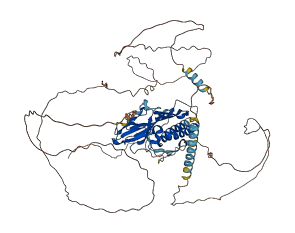
Descriptions
The autoinhibited protein was predicted that may have potential autoinhibitory elements via cis-regPred.
Autoinhibitory domains (AIDs)
Target domain |
|
Relief mechanism |
|
Assay |
cis-regPred |
Accessory elements
No accessory elements
Autoinhibited structure

Activated structure
1 structures for A5DQA8
| Entry ID | Method | Resolution | Chain | Position | Source |
|---|---|---|---|---|---|
| AF-A5DQA8-F1 | Predicted | AlphaFoldDB |
No variants for A5DQA8
| Variant ID(s) | Position | Change | Description | Diseaes Association | Provenance |
|---|---|---|---|---|---|
| No variants for A5DQA8 | |||||
No associated diseases with A5DQA8
1 regional properties for A5DQA8
| Type | Name | Position | InterPro Accession |
|---|---|---|---|
| domain | Autophagy-related protein 13, N-terminal | 14 - 225 | IPR018731 |
2 GO annotations of cellular component
| Name | Definition |
|---|---|
| Atg1/ULK1 kinase complex | A protein complex consisting of Atg1 (or Atg1 homologs e.g. ULK1, ULK2 in mammals) and Atg13 along with other proteins that regulate its function (e.g. Atg17 in yeast or RB1CC1(FIP200) in mammals). This complex has serine/threonine protein kinase activity and is involved in autophagosome formation. |
| phagophore assembly site | Punctate structures proximal to the endoplasmic reticulum which are the sites where the Atg machinery assembles upon autophagy induction. |
No GO annotations of molecular function
| Name | Definition |
|---|---|
| No GO annotations for molecular function |
2 GO annotations of biological process
| Name | Definition |
|---|---|
| autophagosome assembly | The formation of a double membrane-bounded structure, the autophagosome, that occurs when a specialized membrane sac, called the isolation membrane, starts to enclose a portion of the cytoplasm. |
| protein transport | The directed movement of proteins into, out of or within a cell, or between cells, by means of some agent such as a transporter or pore. |
No homologous proteins in AiPD
| UniProt AC | Gene Name | Protein Name | Species | Evidence Code |
|---|---|---|---|---|
| No homologous proteins | ||||
| 10 | 20 | 30 | 40 | 50 | 60 |
| MEKPKQKLTQ | VTVNFFLKTS | QMILQARSLD | EHGKGKLNKW | FNLHTFNSDD | LRSELRLWRS |
| 70 | 80 | 90 | 100 | 110 | 120 |
| TIDLTAVPPM | IVETYLDLGN | LPQGHTLALK | DEHGNLWPVT | KGGSKKTEVV | LERWLVEFDP |
| 130 | 140 | 150 | 160 | 170 | 180 |
| NEFGTIEELP | YIYKQAIILC | RSIYTIIRIM | PAASLRNQSP | HYVLANKIVD | GSKPISSKGR |
| 190 | 200 | 210 | 220 | 230 | 240 |
| IGLSKTIIPH | QMLTDTHVRH | RTFSPIETSL | GTLKVSVAYR | SHCEFTELAE | WDHRELGREK |
| 250 | 260 | 270 | 280 | 290 | 300 |
| EPREDLRQVE | SKGEEDHSIE | SIPYEEKAYK | TDEEKSDKTP | EHVQYKPFKP | EFKQLEAVKL |
| 310 | 320 | 330 | 340 | 350 | 360 |
| EGSDFKSELH | EGTSPLSLSG | SPSSPPRDDK | KRPSIQPFRV | GSIGNSPPPA | SSSLERRISI |
| 370 | 380 | 390 | 400 | 410 | 420 |
| TSNKSTSNAS | LAAVLRNPRS | SFSIPIAGSI | GTGAPVTGGF | PRSVSSSHGY | GYEDSDSAAN |
| 430 | 440 | 450 | 460 | 470 | 480 |
| TPRFSSSFGS | RASRRFSNTS | VRHGSLHDTT | SPLGTSAGSA | TSIPLSGLYI | DDDISDFVRM |
| 490 | 500 | 510 | 520 | 530 | 540 |
| IDSKQDLRFG | HDSGGSGSQS | GSQYEVLNRF | HQLKSQHQQL | GDSVNASVMM | HRKSSSPPGS |
| 550 | 560 | 570 | 580 | 590 | 600 |
| YESHVPSIHS | RLRESSEPHP | APATAPAPGP | LIKPASKMMS | SPVISTTSAH | AMSQTASATT |
| 610 | 620 | 630 | 640 | 650 | 660 |
| RDEIVGLATT | PSTYRKHLHY | ENVFDDDDED | EDHHGYFKAK | ARSKSLSRSH | FDDDDDLLFT |
| MSDTNLAKH |