A5D2W8
Gene name |
hslU |
Protein name |
ATP-dependent protease ATPase subunit HslU |
Names |
Unfoldase HslU |
Species |
Pelotomaculum thermopropionicum (strain DSM 13744 / JCM 10971 / SI) |
KEGG Pathway |
pth:PTH_1250 |
EC number |
|
Protein Class |
|
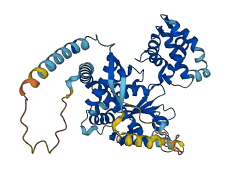
Descriptions
The autoinhibited protein was predicted that may have potential autoinhibitory elements via cis-regPred.
Autoinhibitory domains (AIDs)
Target domain |
|
Relief mechanism |
|
Assay |
cis-regPred |
Accessory elements
No accessory elements
Autoinhibited structure

Activated structure
1 structures for A5D2W8
| Entry ID | Method | Resolution | Chain | Position | Source |
|---|---|---|---|---|---|
| AF-A5D2W8-F1 | Predicted | AlphaFoldDB |
No variants for A5D2W8
| Variant ID(s) | Position | Change | Description | Diseaes Association | Provenance |
|---|---|---|---|---|---|
| No variants for A5D2W8 | |||||
No associated diseases with A5D2W8
4 regional properties for A5D2W8
| Type | Name | Position | InterPro Accession |
|---|---|---|---|
| domain | AAA+ ATPase domain | 49 - 354 | IPR003593 |
| domain | ATPase, AAA-type, core | 53 - 106 | IPR003959-1 |
| domain | ATPase, AAA-type, core | 215 - 351 | IPR003959-2 |
| domain | Clp ATPase, C-terminal | 357 - 448 | IPR019489 |
1 GO annotations of cellular component
| Name | Definition |
|---|---|
| HslUV protease complex | A protein complex that possesses ATP-dependent protease activity; consists of an ATPase large subunit with homology to other ClpX family ATPases and a peptidase small subunit related to the proteasomal beta-subunits of eukaryotes. In the E. coli complex, a double ring-shaped homohexamer of HslV is capped on each side by a ring-shaped HslU homohexamer. |
4 GO annotations of molecular function
| Name | Definition |
|---|---|
| ATP binding | Binding to ATP, adenosine 5'-triphosphate, a universally important coenzyme and enzyme regulator. |
| ATP hydrolysis activity | Catalysis of the reaction: ATP + H2O = ADP + H+ phosphate. ATP hydrolysis is used in some reactions as an energy source, for example to catalyze a reaction or drive transport against a concentration gradient. |
| peptidase activity | Catalysis of the hydrolysis of a peptide bond. A peptide bond is a covalent bond formed when the carbon atom from the carboxyl group of one amino acid shares electrons with the nitrogen atom from the amino group of a second amino acid. |
| proteasome-activating activity | Catalysis of the reaction: ATP + H2O = ADP + phosphate, which promotes unfolding of protein substrates, and channel opening of the core proteasome. |
1 GO annotations of biological process
| Name | Definition |
|---|---|
| protein unfolding | The process of assisting in the disassembly of non-covalent linkages in a protein or protein aggregate, often where the proteins are in a non-functional or denatured state. |
No homologous proteins in AiPD
| UniProt AC | Gene Name | Protein Name | Species | Evidence Code |
|---|---|---|---|---|
| No homologous proteins | ||||
| 10 | 20 | 30 | 40 | 50 | 60 |
| MEELTPRRIV | EELDKYIVGQ | KNAKKAVAIA | LRNRYRRKKL | PEDFKDEVMP | KNILMIGPTG |
| 70 | 80 | 90 | 100 | 110 | 120 |
| VGKTEIARRL | ARLVKAPFVK | VEATKFTEVG | YVGRDVEGMV | RDLVETSIRM | VKQEKMAMVE |
| 130 | 140 | 150 | 160 | 170 | 180 |
| DRAQKMAEEK | IIELLAPYPV | QQTAARNPLE | LLFGAARQAE | QTDKNQEQRI | KRIDFEREML |
| 190 | 200 | 210 | 220 | 230 | 240 |
| REKLARGELE | NEYLEIEVED | SKPPMLEIFT | ASGGMEEMGV | NLQDMLGGLF | PKKKHKRRVT |
| 250 | 260 | 270 | 280 | 290 | 300 |
| VREARKILTQ | QEAQKLIDMD | EVTAAAIKRA | EEDGIIFLDE | IDKIAGREGY | GPDVSRGGVQ |
| 310 | 320 | 330 | 340 | 350 | 360 |
| RDILPIVEGS | TVMTKYGPVK | TDHILFIAAG | AFHISKPSDL | IPELQGRFPI | RVELESLTCE |
| 370 | 380 | 390 | 400 | 410 | 420 |
| DFQQILTEPR | NALIKQYTEL | LATEGVKVKF | TENSLVEIAK | IAYTVNEQTE | NIGARRLHTI |
| 430 | 440 | 450 | 460 | ||
| LEKLLEDISF | EAPELTGKEI | VIDREIVLEK | LGELAKNKDL | SRYIL |