A4YNQ1
Gene name |
acsF |
Protein name |
Aerobic magnesium-protoporphyrin IX monomethyl ester [oxidative] cyclase |
Names |
Aerobic Mg-protoporphyrin IX monomethyl ester oxidative cyclase |
Species |
Bradyrhizobium sp (strain ORS 278) |
KEGG Pathway |
bra:BRADO1649 |
EC number |
1.14.13.81: With NADH or NADPH as one donor, and incorporation of one atom of oxygen |
Protein Class |
|
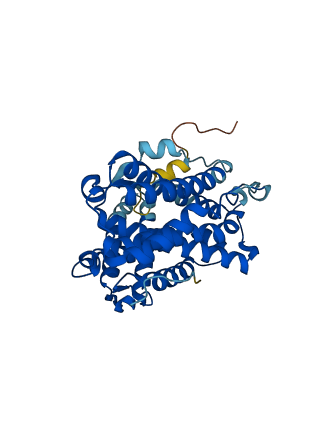
Descriptions
The autoinhibited protein was predicted that may have potential autoinhibitory elements via cis-regPred.
Autoinhibitory domains (AIDs)
Target domain |
|
Relief mechanism |
|
Assay |
cis-regPred |
Accessory elements
No accessory elements
Autoinhibited structure

Activated structure
1 structures for A4YNQ1
| Entry ID | Method | Resolution | Chain | Position | Source |
|---|---|---|---|---|---|
| AF-A4YNQ1-F1 | Predicted | AlphaFoldDB |
No variants for A4YNQ1
| Variant ID(s) | Position | Change | Description | Diseaes Association | Provenance |
|---|---|---|---|---|---|
| No variants for A4YNQ1 | |||||
No associated diseases with A4YNQ1
4 regional properties for A4YNQ1
| Type | Name | Position | InterPro Accession |
|---|---|---|---|
| domain | AMP-dependent synthetase/ligase domain | 92 - 535 | IPR000873 |
| conserved_site | AMP-binding, conserved site | 267 - 278 | IPR020845 |
| domain | AMP-binding enzyme, C-terminal domain | 544 - 625 | IPR025110 |
| domain | Acetyl-coenzyme A synthetase, N-terminal domain | 32 - 87 | IPR032387 |
Functions
| Description | ||
|---|---|---|
| EC Number | 1.14.13.81 | With NADH or NADPH as one donor, and incorporation of one atom of oxygen |
| Subcellular Localization |
|
|
| PANTHER Family | ||
| PANTHER Subfamily | ||
| PANTHER Protein Class | ||
| PANTHER Pathway Category | No pathway information available | |
No GO annotations of cellular component
| Name | Definition |
|---|---|
| No GO annotations for cellular component |
2 GO annotations of molecular function
| Name | Definition |
|---|---|
| iron ion binding | Binding to an iron (Fe) ion. |
| magnesium-protoporphyrin IX monomethyl ester (oxidative) cyclase activity | Catalysis of the reaction: magnesium protoporphyrin IX 13-monomethyl ester + 3 NADPH + 3 H+ + 3 O2 = divinylprotochlorophyllide + 3 NADP+ + 5 H2O. |
2 GO annotations of biological process
| Name | Definition |
|---|---|
| light-independent bacteriochlorophyll biosynthetic process | The chemical reactions and pathways resulting in the formation of a bacteriochlorophyll, which occur in the absence of light. Bacteriochlorophylls are any of the chlorophylls of photosynthetic bacteria; they differ structurally from the chlorophylls of higher plants. |
| photosynthesis | The synthesis by organisms of organic chemical compounds, especially carbohydrates, from carbon dioxide (CO2) using energy obtained from light rather than from the oxidation of chemical compounds. |
No homologous proteins in AiPD
| UniProt AC | Gene Name | Protein Name | Species | Evidence Code |
|---|---|---|---|---|
| No homologous proteins | ||||
| 10 | 20 | 30 | 40 | 50 | 60 |
| MIAMEGGSGN | ISTKMALEDT | ILTPRFYTTD | FAAMDRLNVD | LVRREWDAVM | AELRADHNRK |
| 70 | 80 | 90 | 100 | 110 | 120 |
| HFVRTPEFDK | DLNELPEALR | AEFKDFLVSS | LTAEFSGCVL | YAEIKKRITN | PDIRELFQFM |
| 130 | 140 | 150 | 160 | 170 | 180 |
| SRDEARHAGF | INEILKDHGI | GVDLGFLTKT | KKYTYFKPKF | IFYATYLSEK | IGYARYITIY |
| 190 | 200 | 210 | 220 | 230 | 240 |
| RQMERHPERQ | FHPIFKWFER | WCNDEFRHGE | AFALLMRADP | KLLSGYNKLW | IKFFLLAVFA |
| 250 | 260 | 270 | 280 | 290 | 300 |
| TMHVRDHMRP | AFYEALGMPP | DEYDMRVFRI | TSEISRQVFP | VMLDIDNPRF | WEGLKRLREI |
| 310 | 320 | 330 | 340 | 350 | |
| SEAIAEAKAQ | GGIMGTLKRA | VLPLKAALTF | GRLYMLPAKN | NELPREIRLQ | PAW |