A4YGR1
Gene name |
Msed_1456 |
Protein name |
3-hydroxypropionyl-coenzyme A synthetase |
Names |
3-hydroxypropionyl-CoA synthetase |
Species |
Metallosphaera sedula (strain ATCC 51363 / DSM 5348 / JCM 9185 / NBRC 15509 / TH2) |
KEGG Pathway |
mse:Msed_1456 |
EC number |
6.2.1.36: Acid--thiol ligases |
Protein Class |
|
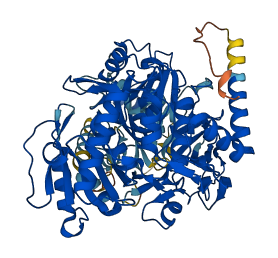
Descriptions
The autoinhibited protein was predicted that may have potential autoinhibitory elements via cis-regPred.
Autoinhibitory domains (AIDs)
Target domain |
|
Relief mechanism |
|
Assay |
cis-regPred |
Accessory elements
No accessory elements
Autoinhibited structure

Activated structure
1 structures for A4YGR1
| Entry ID | Method | Resolution | Chain | Position | Source |
|---|---|---|---|---|---|
| AF-A4YGR1-F1 | Predicted | AlphaFoldDB |
No variants for A4YGR1
| Variant ID(s) | Position | Change | Description | Diseaes Association | Provenance |
|---|---|---|---|---|---|
| No variants for A4YGR1 | |||||
No associated diseases with A4YGR1
4 regional properties for A4YGR1
| Type | Name | Position | InterPro Accession |
|---|---|---|---|
| domain | AMP-dependent synthetase/ligase domain | 97 - 531 | IPR000873 |
| conserved_site | AMP-binding, conserved site | 264 - 275 | IPR020845 |
| domain | AMP-binding enzyme, C-terminal domain | 540 - 617 | IPR025110 |
| domain | Acetyl-coenzyme A synthetase, N-terminal domain | 31 - 85 | IPR032387 |
Functions
| Description | ||
|---|---|---|
| EC Number | 6.2.1.36 | Acid--thiol ligases |
| Subcellular Localization |
|
|
| PANTHER Family | ||
| PANTHER Subfamily | ||
| PANTHER Protein Class | ||
| PANTHER Pathway Category | No pathway information available | |
No GO annotations of cellular component
| Name | Definition |
|---|---|
| No GO annotations for cellular component |
4 GO annotations of molecular function
| Name | Definition |
|---|---|
| 3-hydroxypropionyl-CoA synthetase activity | Catalysis of the reaction: 3-hydroxypropionate + ATP + CoA = 3-hydroxypropionyl-CoA + AMP + diphosphate. |
| acetate-CoA ligase activity | Catalysis of the reaction: ATP + acetate + CoA = AMP + diphosphate + acetyl-CoA. |
| AMP binding | Binding to AMP, adenosine monophosphate. |
| ATP binding | Binding to ATP, adenosine 5'-triphosphate, a universally important coenzyme and enzyme regulator. |
2 GO annotations of biological process
| Name | Definition |
|---|---|
| acetyl-CoA biosynthetic process from acetate | The chemical reactions and pathways resulting in the formation of acetyl-CoA from acetate, either directly or via acetylphosphate. |
| carbon fixation by 3-hydroxypropionate cycle | An autotrophic carbon dioxide fixation pathway by which two molecules of carbon dioxide are fixed to form glyoxylate. Acetyl coenzyme A (acetyl-CoA) is assumed to be converted to malate, and two CO2 molecules are thereby fixed. Malyl-CoA is thought to be cleaved to acetyl-CoA, the starting molecule, and glyoxylate, the carbon fixation product. |
No homologous proteins in AiPD
| UniProt AC | Gene Name | Protein Name | Species | Evidence Code |
|---|---|---|---|---|
| No homologous proteins | ||||
| 10 | 20 | 30 | 40 | 50 | 60 |
| MFMRYIMVEE | QTLKTGSQEL | EEKADYNMRY | YAHLMKLSKE | KPAEFWGSLA | QDLLDWYEPW |
| 70 | 80 | 90 | 100 | 110 | 120 |
| KETMRQEDPM | TRWFIGGKIN | ASYNAVDRHL | NGPRKFKAAV | IWESELGERK | IVTYQDMFYE |
| 130 | 140 | 150 | 160 | 170 | 180 |
| VNRWANALRS | LGVGKGDRVT | IYMPLTPEGI | AAMLASARIG | AIHSVIFAGF | GSQAIADRVE |
| 190 | 200 | 210 | 220 | 230 | 240 |
| DAKAKVVITA | DAYPRRGKVV | ELKKTVDEAL | NSLGERSPVQ | HVLVYRRMKT | DVNMKEGRDV |
| 250 | 260 | 270 | 280 | 290 | 300 |
| FFDEVGKYRY | VEPERMDSND | PLFILYTSGT | TGKPKGIMHS | TGGYLTGTAV | MLLWSYGLSQ |
| 310 | 320 | 330 | 340 | 350 | 360 |
| ENDVLFNTSD | IGWIVGHSYI | TYSPLIMGRT | VVIYESAPDY | PYPDKWAEII | ERYRATTFGT |
| 370 | 380 | 390 | 400 | 410 | 420 |
| SATALRYFMK | YGDEYVKNHD | LSSIRIIVTN | GEVLNYSPWK | WGLEVLGGGK | VFMSHQWWQT |
| 430 | 440 | 450 | 460 | 470 | 480 |
| ETGAPNLGYL | PGIIYMPMKS | GPASGFPLPG | NFVEVLDENG | NPSAPRVRGY | LVMRPPFPPN |
| 490 | 500 | 510 | 520 | 530 | 540 |
| MMMGMWNDNG | ERLKKTYFSK | FGSLYYPGDF | AMVDEDGYIW | VLGRADETLK | IAAHRIGAGE |
| 550 | 560 | 570 | 580 | 590 | 600 |
| VESAITSHPS | VAEAAVIGVP | DSVKGEEVHA | FVVLKQGYAP | SSELAKDIQS | HVRKVMGPIV |
| 610 | 620 | 630 | 640 | 650 | 660 |
| SPQIHFVDKL | PKTRSGKVMR | RVIKAVMMGS | SAGDLTTIED | EASMDEIKKA | VEELKKELKT |
| S |