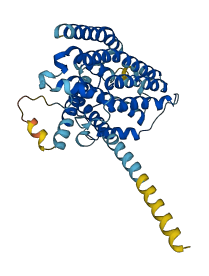
Descriptions
The autoinhibited protein was predicted that may have potential autoinhibitory elements via cis-regPred.
Autoinhibitory domains (AIDs)
Target domain |
|
Relief mechanism |
|
Assay |
cis-regPred |
Accessory elements
No accessory elements
Autoinhibited structure

Activated structure
1 structures for A4QJQ5
| Entry ID | Method | Resolution | Chain | Position | Source |
|---|---|---|---|---|---|
| AF-A4QJQ5-F1 | Predicted | AlphaFoldDB |
No variants for A4QJQ5
| Variant ID(s) | Position | Change | Description | Diseaes Association | Provenance |
|---|---|---|---|---|---|
| No variants for A4QJQ5 | |||||
No associated diseases with A4QJQ5
7 regional properties for A4QJQ5
| Type | Name | Position | InterPro Accession |
|---|---|---|---|
| conserved_site | Twin-arginine translocation pathway, signal sequence | 1 - 38 | IPR006311 |
| domain | Molybdopterin oxidoreductase | 98 - 571 | IPR006656 |
| domain | Molybdopterin dinucleotide-binding domain | 717 - 825 | IPR006657 |
| domain | Molybdopterin oxidoreductase, 4Fe-4S domain | 41 - 97 | IPR006963 |
| conserved_site | Twin-arginine translocation pathway, signal sequence, bacterial/archaeal | 5 - 25 | IPR019546 |
| binding_site | Molybdopterin oxidoreductase, molybdopterin cofactor binding site | 46 - 64 | IPR027467 |
| domain | Nitrate reductase NapA-like, molybdopterin-binding domain | 714 - 831 | IPR041957 |
2 GO annotations of cellular component
| Name | Definition |
|---|---|
| chloroplast thylakoid membrane | The pigmented membrane of a chloroplast thylakoid. An example of this component is found in Arabidopsis thaliana. |
| integral component of membrane | The component of a membrane consisting of the gene products and protein complexes having at least some part of their peptide sequence embedded in the hydrophobic region of the membrane. |
2 GO annotations of molecular function
| Name | Definition |
|---|---|
| oxidoreductase activity, acting on NAD(P)H, quinone or similar compound as acceptor | Catalysis of an oxidation-reduction (redox) reaction in which NADH or NADPH acts as a hydrogen or electron donor and reduces a quinone or a similar acceptor molecule. |
| quinone binding | Binding to a quinone, any member of a class of diketones derivable from aromatic compounds by conversion of two CH groups into CO groups with any necessary rearrangement of double bonds. |
1 GO annotations of biological process
| Name | Definition |
|---|---|
| photosynthesis, light reaction | The light reactions of photosynthesis, which take place in photosystems II and I. Light energy is harvested and used to power the transfer of electrons among a series of electron donors and acceptors. The final electron acceptor is NADP+, which is reduced to NADPH. NADPH generated from light reactions is used in sugar synthesis in dark reactions. Light reactions also generate a proton motive force across the thylakoid membrane, and the proton gradient is used to synthesize ATP. There are two chemical reactions involved in the light reactions: water oxidation in photosystem II, and NADP reduction in photosystem I. |
No homologous proteins in AiPD
| UniProt AC | Gene Name | Protein Name | Species | Evidence Code |
|---|---|---|---|---|
| No homologous proteins | ||||
| 10 | 20 | 30 | 40 | 50 | 60 |
| MRIFATEVQT | INSFVRLESF | KEVYGLIWEF | LPIFSLVLGI | LTGVLVLVWL | EREISARIQQ |
| 70 | 80 | 90 | 100 | 110 | 120 |
| RIGPEYAGAL | GILQALADGI | KLLFKENLRP | SIGNTTLFSI | GPSIAVISIL | LSYSVIPFSN |
| 130 | 140 | 150 | 160 | 170 | 180 |
| HLVLADFNIG | IFLWIAISSI | APIGLLMSGY | GSNNKYSFLG | GLRAAAQSIS | YEIPLTLCLL |
| 190 | 200 | 210 | 220 | 230 | 240 |
| SISLLSNSLS | TVDIVEAQSK | YGFWGWNLWR | QPIGFIIFLI | SSLAECERLP | FDLPEAEEEL |
| 250 | 260 | 270 | 280 | 290 | 300 |
| VAGYQTEYSG | IKFGLFYVAS | YLNLLISSLF | VTVLYLGGWN | ISIPYISILE | LFERDQIFGT |
| 310 | 320 | 330 | 340 | 350 | |
| TIGIFITLAK | TYLFLFISIT | TRWTLPRLRI | DQLLNFGWKF | LLPISLGNLL | LTTSFQVFSL |