A4K2Q5
Gene name |
STK4 |
Protein name |
Serine/threonine-protein kinase 4 |
Names |
|
Species |
Otolemur garnettii (Small-eared galago) (Garnett's greater bushbaby) |
KEGG Pathway |
oga:100959420 |
EC number |
2.7.11.1: Protein-serine/threonine kinases |
Protein Class |
|
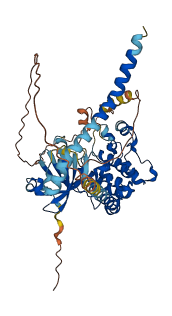
Descriptions
The autoinhibited protein was predicted that may have potential autoinhibitory elements via cis-regPred.
Autoinhibitory domains (AIDs)
Target domain |
|
Relief mechanism |
|
Assay |
cis-regPred |
Accessory elements
166-189 (Activation loop from InterPro)
Target domain |
30-281 (Protein kinase domain) |
Relief mechanism |
|
Assay |
|
Autoinhibited structure

Activated structure
1 structures for A4K2Q5
| Entry ID | Method | Resolution | Chain | Position | Source |
|---|---|---|---|---|---|
| AF-A4K2Q5-F1 | Predicted | AlphaFoldDB |
No variants for A4K2Q5
| Variant ID(s) | Position | Change | Description | Diseaes Association | Provenance |
|---|---|---|---|---|---|
| No variants for A4K2Q5 | |||||
No associated diseases with A4K2Q5
Functions
| Description | ||
|---|---|---|
| EC Number | 2.7.11.1 | Protein-serine/threonine kinases |
| Subcellular Localization |
|
|
| PANTHER Family | ||
| PANTHER Subfamily | ||
| PANTHER Protein Class | ||
| PANTHER Pathway Category | No pathway information available | |
5 GO annotations of cellular component
| Name | Definition |
|---|---|
| cytoplasm | The contents of a cell excluding the plasma membrane and nucleus, but including other subcellular structures. |
| cytosol | The part of the cytoplasm that does not contain organelles but which does contain other particulate matter, such as protein complexes. |
| nuclear body | Extra-nucleolar nuclear domains usually visualized by confocal microscopy and fluorescent antibodies to specific proteins. |
| nucleus | A membrane-bounded organelle of eukaryotic cells in which chromosomes are housed and replicated. In most cells, the nucleus contains all of the cell's chromosomes except the organellar chromosomes, and is the site of RNA synthesis and processing. In some species, or in specialized cell types, RNA metabolism or DNA replication may be absent. |
| protein-containing complex | A stable assembly of two or more macromolecules, i.e. proteins, nucleic acids, carbohydrates or lipids, in which at least one component is a protein and the constituent parts function together. |
6 GO annotations of molecular function
| Name | Definition |
|---|---|
| ATP binding | Binding to ATP, adenosine 5'-triphosphate, a universally important coenzyme and enzyme regulator. |
| magnesium ion binding | Binding to a magnesium (Mg) ion. |
| protein homodimerization activity | Binding to an identical protein to form a homodimer. |
| protein serine kinase activity | Catalysis of the reactions: ATP + protein serine = ADP + protein serine phosphate. |
| protein serine/threonine kinase activity | Catalysis of the reactions: ATP + protein serine = ADP + protein serine phosphate, and ATP + protein threonine = ADP + protein threonine phosphate. |
| RNA polymerase II-specific DNA-binding transcription factor binding | Binding to a sequence-specific DNA binding RNA polymerase II transcription factor, any of the factors that interact selectively and non-covalently with a specific DNA sequence in order to modulate transcription. |
30 GO annotations of biological process
| Name | Definition |
|---|---|
| apoptotic process | A programmed cell death process which begins when a cell receives an internal (e.g. DNA damage) or external signal (e.g. an extracellular death ligand), and proceeds through a series of biochemical events (signaling pathway phase) which trigger an execution phase. The execution phase is the last step of an apoptotic process, and is typically characterized by rounding-up of the cell, retraction of pseudopodes, reduction of cellular volume (pyknosis), chromatin condensation, nuclear fragmentation (karyorrhexis), plasma membrane blebbing and fragmentation of the cell into apoptotic bodies. When the execution phase is completed, the cell has died. |
| branching involved in blood vessel morphogenesis | The process of coordinated growth and sprouting of blood vessels giving rise to the organized vascular system. |
| canonical Wnt signaling pathway | The series of molecular signals initiated by binding of a Wnt protein to a frizzled family receptor on the surface of the target cell, followed by propagation of the signal via beta-catenin, and ending with a change in transcription of target genes. In this pathway, the activated receptor signals via downstream effectors that result in the inhibition of beta-catenin phosphorylation, thereby preventing degradation of beta-catenin. Stabilized beta-catenin can then accumulate and travel to the nucleus to trigger changes in transcription of target genes. |
| cell differentiation involved in embryonic placenta development | The process in which a relatively unspecialized cell acquires specialized features of the embryonic placenta. |
| cell morphogenesis | The developmental process in which the size or shape of a cell is generated and organized. |
| central nervous system development | The process whose specific outcome is the progression of the central nervous system over time, from its formation to the mature structure. The central nervous system is the core nervous system that serves an integrating and coordinating function. In vertebrates it consists of the brain and spinal cord. In those invertebrates with a central nervous system it typically consists of a brain, cerebral ganglia and a nerve cord. |
| endocardium development | The process whose specific outcome is the progression of the endocardium over time, from its formation to the mature structure. The endocardium is an anatomical structure comprised of an endothelium and an extracellular matrix that forms the innermost layer of tissue of the heart, and lines the heart chambers. |
| epithelial cell proliferation | The multiplication or reproduction of epithelial cells, resulting in the expansion of a cell population. Epithelial cells make up the epithelium, the covering of internal and external surfaces of the body, including the lining of vessels and other small cavities. It consists of cells joined by small amounts of cementing substances. |
| extrinsic apoptotic signaling pathway via death domain receptors | The series of molecular signals in which a signal is conveyed from the cell surface to trigger the apoptotic death of a cell. The pathway starts with a ligand binding to a death domain receptor on the cell surface, and ends when the execution phase of apoptosis is triggered. |
| hepatocyte apoptotic process | Any apoptotic process in a hepatocyte, the main structural component of the liver. |
| hippo signaling | The series of molecular signals mediated by the serine/threonine kinase Hippo or one of its orthologs. In Drosophila, Hippo in complex with the scaffold protein Salvador (Sav), phosphorylates and activates Warts (Wts), which in turn phosphorylates and inactivates the Yorkie (Yki) transcriptional activator. The core fly components hippo, sav, wts and mats are conserved in mammals as STK4/3 (MST1/2), SAV1/WW45, LATS1/2 and MOB1. |
| keratinocyte differentiation | The process in which a relatively unspecialized cell acquires specialized features of a keratinocyte. |
| negative regulation of canonical Wnt signaling pathway | Any process that decreases the rate, frequency, or extent of the Wnt signaling pathway through beta-catenin, the series of molecular signals initiated by binding of a Wnt protein to a frizzled family receptor on the surface of the target cell, followed by propagation of the signal via beta-catenin, and ending with a change in transcription of target genes. |
| negative regulation of epithelial cell proliferation | Any process that stops, prevents or reduces the rate or extent of epithelial cell proliferation. |
| negative regulation of organ growth | Any process that stops, prevents, or reduces the frequency, rate or extent of growth of an organ of an organism. |
| neural tube formation | The formation of a tube from the flat layer of ectodermal cells known as the neural plate. This will give rise to the central nervous system. |
| organ growth | The increase in size or mass of an organ. Organs are commonly observed as visibly distinct structures, but may also exist as loosely associated clusters of cells that function together as to perform a specific function. |
| peptidyl-serine phosphorylation | The phosphorylation of peptidyl-serine to form peptidyl-O-phospho-L-serine. |
| positive regulation of extrinsic apoptotic signaling pathway via death domain receptors | Any process that activates or increases the frequency, rate or extent of extrinsic apoptotic signaling pathway via death domain receptors. |
| positive regulation of fat cell differentiation | Any process that activates or increases the frequency, rate or extent of adipocyte differentiation. |
| positive regulation of hepatocyte apoptotic process | Any process that activates or increases the frequency, rate or extent of hepatocyte apoptotic process. |
| positive regulation of peptidyl-serine phosphorylation | Any process that activates or increases the frequency, rate or extent of the phosphorylation of peptidyl-serine. |
| positive regulation of protein binding | Any process that activates or increases the frequency, rate or extent of protein binding. |
| positive regulation of substrate-dependent cell migration, cell attachment to substrate | Any process that activates or increases the frequency, rate or extent of substrate-dependent cell migration, cell attachment to substrate. |
| primitive hemopoiesis | A first transient wave of blood cell production that, in vertebrates, gives rise to erythrocytes (red blood cells) and myeloid cells. |
| protein autophosphorylation | The phosphorylation by a protein of one or more of its own amino acid residues (cis-autophosphorylation), or residues on an identical protein (trans-autophosphorylation). |
| protein import into nucleus | The directed movement of a protein from the cytoplasm to the nucleus. |
| protein stabilization | Any process involved in maintaining the structure and integrity of a protein and preventing it from degradation or aggregation. |
| protein tetramerization | The formation of a protein tetramer, a macromolecular structure consisting of four noncovalently associated identical or nonidentical subunits. |
| regulation of cell differentiation involved in embryonic placenta development | Any process that modulates the rate, frequency or extent of cell differentiation that contributes to the progression of the placenta over time, from its initial condition to its mature state. |
No homologous proteins in AiPD
| UniProt AC | Gene Name | Protein Name | Species | Evidence Code |
|---|---|---|---|---|
| No homologous proteins | ||||
| 10 | 20 | 30 | 40 | 50 | 60 |
| METVQLRNPP | RRQLKKLDED | SLTKQPEEVF | DVLEKLGEGS | YGSVYKAIHK | ETGQIVAIKQ |
| 70 | 80 | 90 | 100 | 110 | 120 |
| VPVESDLQEI | IKEISIMQQC | DSPHVVKYYG | SYFKNTDLWI | VMEYCGAGSV | SDIIRLRNKT |
| 130 | 140 | 150 | 160 | 170 | 180 |
| LTEDEIATIL | QSTLKGLEYL | HFMRKIHRDI | KAGNILLNTE | GHAKLADFGV | AGQLTDTMAK |
| 190 | 200 | 210 | 220 | 230 | 240 |
| RNTVIGTPFW | MAPEVIQEIG | YNCVADIWSL | GITAIEMAEG | KPPYADIHPM | RAIFMIPTNP |
| 250 | 260 | 270 | 280 | 290 | 300 |
| PPTFRKPELW | SDNFTDFVRQ | CLVKSPDQRA | TATQLLQHPF | VKSAKGVSIL | RDLINEAMDV |
| 310 | 320 | 330 | 340 | 350 | 360 |
| KLKRQEAQQR | EVDQDDEENS | EEDELDSGTM | VRAVGDEMGT | VRVASTMSDG | ANTMIEHDDT |
| 370 | 380 | 390 | 400 | 410 | 420 |
| LPSQLGTMVI | NADDEEEEGT | MKRRDETMQP | AKPSFLEYFE | QKEKENQINS | FGKSVPGPLK |
| 430 | 440 | 450 | 460 | 470 | 480 |
| NSSDWKVPQD | GDYEFLKSWT | VEDLQKRLLA | LDPMMEQEIE | EIRQKYQSKR | QPILDAIEAK |
| KRRQQNF |