A4FG06
Gene name |
ku2 |
Protein name |
Non-homologous end joining protein Ku 2 |
Names |
|
Species |
Saccharopolyspora erythraea (strain ATCC 11635 / DSM 40517 / JCM 4748 / NBRC 13426 / NCIMB 8594 / NRRL 2338) |
KEGG Pathway |
sen:SACE_3709 |
EC number |
|
Protein Class |
|
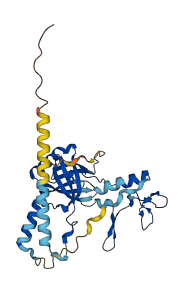
Descriptions
The autoinhibited protein was predicted that may have potential autoinhibitory elements via cis-regPred.
Autoinhibitory domains (AIDs)
Target domain |
|
Relief mechanism |
|
Assay |
cis-regPred |
Accessory elements
No accessory elements
Autoinhibited structure

Activated structure
1 structures for A4FG06
| Entry ID | Method | Resolution | Chain | Position | Source |
|---|---|---|---|---|---|
| AF-A4FG06-F1 | Predicted | AlphaFoldDB |
No variants for A4FG06
| Variant ID(s) | Position | Change | Description | Diseaes Association | Provenance |
|---|---|---|---|---|---|
| No variants for A4FG06 | |||||
No associated diseases with A4FG06
5 regional properties for A4FG06
| Type | Name | Position | InterPro Accession |
|---|---|---|---|
| domain | Aminoacyl-tRNA synthetase, class II (D/K/N) | 155 - 492 | IPR004364 |
| domain | OB-fold nucleic acid binding domain, AA-tRNA synthetase-type | 55 - 131 | IPR004365 |
| domain | Aminoacyl-tRNA synthetase, class II | 179 - 494 | IPR006195 |
| domain | Lysyl-tRNA synthetase, class II, C-terminal | 169 - 494 | IPR018149 |
| domain | Lysine-tRNA ligase, class II, N-terminal | 53 - 166 | IPR044136 |
No GO annotations of cellular component
| Name | Definition |
|---|---|
| No GO annotations for cellular component |
1 GO annotations of molecular function
| Name | Definition |
|---|---|
| double-stranded DNA binding | Binding to double-stranded DNA. |
2 GO annotations of biological process
| Name | Definition |
|---|---|
| DNA recombination | Any process in which a new genotype is formed by reassortment of genes resulting in gene combinations different from those that were present in the parents. In eukaryotes genetic recombination can occur by chromosome assortment, intrachromosomal recombination, or nonreciprocal interchromosomal recombination. Interchromosomal recombination occurs by crossing over. In bacteria it may occur by genetic transformation, conjugation, transduction, or F-duction. |
| double-strand break repair via nonhomologous end joining | The repair of a double-strand break in DNA in which the two broken ends are rejoined with little or no sequence complementarity. Information at the DNA ends may be lost due to the modification of broken DNA ends. This term covers instances of separate pathways, called classical (or canonical) and alternative nonhomologous end joining (C-NHEJ and A-NHEJ). These in turn may further branch into sub-pathways, but evidence is still unclear. |
No homologous proteins in AiPD
| UniProt AC | Gene Name | Protein Name | Species | Evidence Code |
|---|---|---|---|---|
| No homologous proteins | ||||
| 10 | 20 | 30 | 40 | 50 | 60 |
| MINSPPIGYL | PGMRTMWRGA | ISFGLVNIGV | RLYAATADHD | YQFHQVHRQD | HGRIHHKRVC |
| 70 | 80 | 90 | 100 | 110 | 120 |
| EECGREIDYD | DIVKGYETSD | GELVVLDSQD | LRKLPIRTDR | AIDLLECVPA | EQVDPTYFQK |
| 130 | 140 | 150 | 160 | 170 | 180 |
| TYYLEPEKSA | RRPYVLLREA | LRRTDLLAVV | KITMRQRETL | ATIRPAGDVL | VLHTMLWPDE |
| 190 | 200 | 210 | 220 | 230 | 240 |
| IRRPDFDFLT | DDAGDTEVSK | QEIDMATSLV | ENMTEDFDPT | EFTDDYQRAL | AELIDAKTKG |
| 250 | 260 | 270 | 280 | 290 | 300 |
| TKPPRKRPEP | ADEGEVVDLM | GALERSVDQA | RTSRTSRRKT | TASASRRRSS | SNREKTGSRD |
| KTRKRA |