A4D2B8
Descriptions
The autoinhibited protein was predicted that may have potential autoinhibitory elements via cis-regPred.
Autoinhibitory domains (AIDs)
Target domain |
|
Relief mechanism |
|
Assay |
cis-regPred |
Accessory elements
No accessory elements
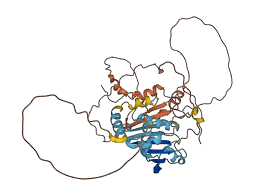
Autoinhibited structure

Activated structure
1 structures for A4D2B8
| Entry ID | Method | Resolution | Chain | Position | Source |
|---|---|---|---|---|---|
| AF-A4D2B8-F1 | Predicted | AlphaFoldDB |
No variants for A4D2B8
| Variant ID(s) | Position | Change | Description | Diseaes Association | Provenance |
|---|---|---|---|---|---|
| No variants for A4D2B8 | |||||
No associated diseases with A4D2B8
1 regional properties for A4D2B8
| Type | Name | Position | InterPro Accession |
|---|---|---|---|
| conserved_site | DNA mismatch repair, conserved site | 305 - 311 | IPR014762 |
2 GO annotations of cellular component
| Name | Definition |
|---|---|
| mismatch repair complex | Any complex formed of proteins that act in mismatch repair. |
| MutLalpha complex | A heterodimer involved in the recognition of base-base and small insertion/deletion mismatches. In human the complex consists of two subunits, MLH1 and PMS2. |
3 GO annotations of molecular function
| Name | Definition |
|---|---|
| ATP hydrolysis activity | Catalysis of the reaction: ATP + H2O = ADP + H+ phosphate. ATP hydrolysis is used in some reactions as an energy source, for example to catalyze a reaction or drive transport against a concentration gradient. |
| ATP-dependent DNA damage sensor activity | A molecule that recognises toxic DNA structures, and initiates a signalling response, driven by ATP hydrolysis. |
| kinase activity | Catalysis of the transfer of a phosphate group, usually from ATP, to a substrate molecule. |
3 GO annotations of biological process
| Name | Definition |
|---|---|
| mismatch repair | A system for the correction of errors in which an incorrect base, which cannot form hydrogen bonds with the corresponding base in the parent strand, is incorporated into the daughter strand. The mismatch repair system promotes genomic fidelity by repairing base-base mismatches, insertion-deletion loops and heterologies generated during DNA replication and recombination. |
| phosphorylation | The process of introducing a phosphate group into a molecule, usually with the formation of a phosphoric ester, a phosphoric anhydride or a phosphoric amide. |
| somatic hypermutation of immunoglobulin genes | Mutations occurring somatically that result in amino acid changes in the rearranged V regions of immunoglobulins. |
No homologous proteins in AiPD
| UniProt AC | Gene Name | Protein Name | Species | Evidence Code |
|---|---|---|---|---|
| No homologous proteins | ||||
| 10 | 20 | 30 | 40 | 50 | 60 |
| MVTMCGGHRP | ENFLHQVLTE | FGEELAGEGK | SEVGGGAPRS | YLQVASAECW | AAAPAVHVGE |
| 70 | 80 | 90 | 100 | 110 | 120 |
| PVHAGGLHTE | RGADPVIGLY | LVHRGGACQT | PTVGNRQTPT | LGIHARPRRR | ATTSLLTLLL |
| 130 | 140 | 150 | 160 | 170 | 180 |
| AFGKNAVRCA | LIGPGSLTSR | TRPLTEPLGE | KERREVFFPP | RPERVEHNVE | SSRWEPRRRG |
| 190 | 200 | 210 | 220 | 230 | 240 |
| ACGSRGGNFP | SPRGGSGVAS | LERAESSSTE | PAKAIKPIDR | KSVHQICSGP | VVPSLSTAVK |
| 250 | 260 | 270 | 280 | 290 | 300 |
| ELVENSLDAG | ATNIDLKLKD | YGVDLIEVSG | NGCGVEEENF | EGLTLKHHTS | KIQEFADLPQ |
| 310 | 320 | 330 | 340 | 350 | 360 |
| VETFGFRGEA | LSSLCALSDV | TISTCHVSAK | VGTRLVFDHY | GKIIQKTPYP | HPRGMTVSVK |
| 370 | 380 | 390 | 400 | 410 | 420 |
| QLFSTLPVHH | KEFQRNIKKK | RACFPFAFCR | DCQFPEASPA | MLPVQPAELT | PRSTPPHPCS |
| 430 | |||||
| LEDNVITVFS | SVKNGPGSSR |