A3N2U5
Gene name |
atpG |
Protein name |
ATP synthase gamma chain |
Names |
ATP synthase F1 sector gamma subunit, F-ATPase gamma subunit |
Species |
Actinobacillus pleuropneumoniae serotype 5b (strain L20) |
KEGG Pathway |
apl:APL_1647 |
EC number |
|
Protein Class |
|
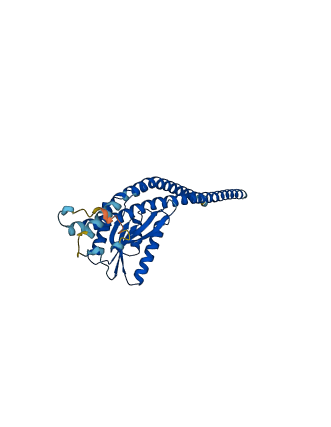
Descriptions
The autoinhibited protein was predicted that may have potential autoinhibitory elements via cis-regPred.
Autoinhibitory domains (AIDs)
Target domain |
|
Relief mechanism |
|
Assay |
cis-regPred |
Accessory elements
No accessory elements
Autoinhibited structure

Activated structure
1 structures for A3N2U5
| Entry ID | Method | Resolution | Chain | Position | Source |
|---|---|---|---|---|---|
| AF-A3N2U5-F1 | Predicted | AlphaFoldDB |
No variants for A3N2U5
| Variant ID(s) | Position | Change | Description | Diseaes Association | Provenance |
|---|---|---|---|---|---|
| No variants for A3N2U5 | |||||
No associated diseases with A3N2U5
1 regional properties for A3N2U5
| Type | Name | Position | InterPro Accession |
|---|---|---|---|
| conserved_site | ATP synthase, F1 complex, gamma subunit conserved site | 274 - 287 | IPR023632 |
2 GO annotations of cellular component
| Name | Definition |
|---|---|
| plasma membrane | The membrane surrounding a cell that separates the cell from its external environment. It consists of a phospholipid bilayer and associated proteins. |
| proton-transporting ATP synthase complex, catalytic core F(1) | The sector of a hydrogen-transporting ATP synthase complex in which the catalytic activity resides; it comprises the catalytic core and central stalk, and is peripherally associated with a membrane, such as the plasma membrane or the mitochondrial inner membrane, when the entire ATP synthase is assembled. |
2 GO annotations of molecular function
| Name | Definition |
|---|---|
| ATP binding | Binding to ATP, adenosine 5'-triphosphate, a universally important coenzyme and enzyme regulator. |
| proton-transporting ATP synthase activity, rotational mechanism | Enables the synthesis of ATP from ADP and phosphate by the transfer of protons from one side of a membrane to the other by a rotational mechanism driven by a gradient according to the reaction: ADP + H2O + phosphate + H+(in) -> ATP + H+(out). |
1 GO annotations of biological process
| Name | Definition |
|---|---|
| proton motive force-driven plasma membrane ATP synthesis | The transport of protons across the plasma membrane to generate an electrochemical gradient (proton-motive force) that powers ATP synthesis. |
No homologous proteins in AiPD
| UniProt AC | Gene Name | Protein Name | Species | Evidence Code |
|---|---|---|---|---|
| No homologous proteins | ||||
| 10 | 20 | 30 | 40 | 50 | 60 |
| MAGAKEIRTK | IASVKNTQKI | TKAMEMVATS | KMRKTQERMA | ASRPYSETIR | KVISHIAKGS |
| 70 | 80 | 90 | 100 | 110 | 120 |
| IGYKHPFLTE | RDIKKVGYLV | VSTDRGLCGG | LNINLFKATL | NEFKTWKDKD | VSVELGLVGS |
| 130 | 140 | 150 | 160 | 170 | 180 |
| KGVSFYQNLG | LNVRSQVTGL | GDNPEMERIV | GAVNEMINAF | RNGEVDAVYV | AYNRFENTMS |
| 190 | 200 | 210 | 220 | 230 | 240 |
| QKPVIAQLLP | LPKLDDDELD | TKGSWDYIYE | PNPQVLLDSL | LVRYLETQVY | QAVVDNLASE |
| 250 | 260 | 270 | 280 | ||
| QAARMVAMKA | ATDNAGTLID | ELQLVYNKAR | QASITNELNE | IVAGAAAI |