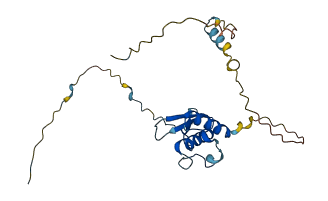
Descriptions
The autoinhibited protein was predicted that may have potential autoinhibitory elements via cis-regPred.
Autoinhibitory domains (AIDs)
Target domain |
|
Relief mechanism |
|
Assay |
cis-regPred |
Accessory elements
No accessory elements
Autoinhibited structure

Activated structure
1 structures for A2WZI4
| Entry ID | Method | Resolution | Chain | Position | Source |
|---|---|---|---|---|---|
| AF-A2WZI4-F1 | Predicted | AlphaFoldDB |
No variants for A2WZI4
| Variant ID(s) | Position | Change | Description | Diseaes Association | Provenance |
|---|---|---|---|---|---|
| No variants for A2WZI4 | |||||
4 associated diseases with A2WZI4
[MIM: 169400]: Pelger-Huet anomaly (PHA)
An autosomal dominant inherited abnormality of granulocytes, characterized by abnormal ovoid shape, reduced nuclear segmentation and an apparently looser chromatin structure. {ECO:0000269|PubMed:14617022}. Note=The disease is caused by variants affecting the gene represented in this entry.
[MIM: 215140]: Greenberg dysplasia (GRBGD)
A rare autosomal recessive chondrodystrophy characterized by early in utero lethality. Affected fetuses typically present with fetal hydrops, short-limbed dwarfism, and a marked disorganization of chondro-osseous calcification, and ectopic ossification centers. {ECO:0000269|PubMed:12618959, ECO:0000269|PubMed:21327084, ECO:0000269|PubMed:27336722}. Note=The disease is caused by variants affecting the gene represented in this entry.
[MIM: 613471]: Reynolds syndrome (REYNS)
A syndrome specifically associating limited cutaneous systemic sclerosis and primary biliary cirrhosis. It is characterized by liver disease, telangiectasia, abrupt onset of digital paleness or cyanosis in response to cold exposure or stress (Raynaud phenomenon), and variable features of scleroderma. The liver disease is characterized by pruritis, jaundice, hepatomegaly, increased serum alkaline phosphatase and positive serum mitochondrial autoantibodies, all consistent with primary biliary cirrhosis. {ECO:0000269|PubMed:20522425}. Note=The disease may be caused by variants affecting the gene represented in this entry.
[MIM: 618019]: Pelger-Huet anomaly with mild skeletal anomalies (PHASK)
A disease characterized by abnormal nuclear shape and chromatin organization in blood granulocytes, short stature, and mild skeletal anomalies. Initial skeletal features may improve with age. {ECO:0000269|PubMed:23824842, ECO:0000269|PubMed:25348816}. Note=The disease is caused by variants affecting the gene represented in this entry.
Without disease ID
- An autosomal dominant inherited abnormality of granulocytes, characterized by abnormal ovoid shape, reduced nuclear segmentation and an apparently looser chromatin structure. {ECO:0000269|PubMed:14617022}. Note=The disease is caused by variants affecting the gene represented in this entry.
- A rare autosomal recessive chondrodystrophy characterized by early in utero lethality. Affected fetuses typically present with fetal hydrops, short-limbed dwarfism, and a marked disorganization of chondro-osseous calcification, and ectopic ossification centers. {ECO:0000269|PubMed:12618959, ECO:0000269|PubMed:21327084, ECO:0000269|PubMed:27336722}. Note=The disease is caused by variants affecting the gene represented in this entry.
- A syndrome specifically associating limited cutaneous systemic sclerosis and primary biliary cirrhosis. It is characterized by liver disease, telangiectasia, abrupt onset of digital paleness or cyanosis in response to cold exposure or stress (Raynaud phenomenon), and variable features of scleroderma. The liver disease is characterized by pruritis, jaundice, hepatomegaly, increased serum alkaline phosphatase and positive serum mitochondrial autoantibodies, all consistent with primary biliary cirrhosis. {ECO:0000269|PubMed:20522425}. Note=The disease may be caused by variants affecting the gene represented in this entry.
- A disease characterized by abnormal nuclear shape and chromatin organization in blood granulocytes, short stature, and mild skeletal anomalies. Initial skeletal features may improve with age. {ECO:0000269|PubMed:23824842, ECO:0000269|PubMed:25348816}. Note=The disease is caused by variants affecting the gene represented in this entry.
3 regional properties for A2WZI4
| Type | Name | Position | InterPro Accession |
|---|---|---|---|
| domain | BRCT domain | 1 - 82 | IPR001357-1 |
| domain | BRCT domain | 111 - 220 | IPR001357-2 |
| domain | BRCT domain | 322 - 412 | IPR001357-3 |
1 GO annotations of cellular component
| Name | Definition |
|---|---|
| nucleus | A membrane-bounded organelle of eukaryotic cells in which chromosomes are housed and replicated. In most cells, the nucleus contains all of the cell's chromosomes except the organellar chromosomes, and is the site of RNA synthesis and processing. In some species, or in specialized cell types, RNA metabolism or DNA replication may be absent. |
2 GO annotations of molecular function
| Name | Definition |
|---|---|
| DNA binding | Any molecular function by which a gene product interacts selectively and non-covalently with DNA (deoxyribonucleic acid). |
| DNA-binding transcription factor activity | A transcription regulator activity that modulates transcription of gene sets via selective and non-covalent binding to a specific double-stranded genomic DNA sequence (sometimes referred to as a motif) within a cis-regulatory region. Regulatory regions include promoters (proximal and distal) and enhancers. Genes are transcriptional units, and include bacterial operons. |
No GO annotations of biological process
| Name | Definition |
|---|---|
| No GO annotations for biological process |
No homologous proteins in AiPD
| UniProt AC | Gene Name | Protein Name | Species | Evidence Code |
|---|---|---|---|---|
| No homologous proteins | ||||
| 10 | 20 | 30 | 40 | 50 | 60 |
| MDTEDTSSAS | SSSVSPPSSP | GGGHHHRLPP | KRRAGRKKFR | ETRHPVYRGV | RARAGGSRWV |
| 70 | 80 | 90 | 100 | 110 | 120 |
| CEVREPQAQA | RIWLGTYPTP | EMAARAHDVA | AIALRGERGA | ELNFPDSPST | LPRARTASPE |
| 130 | 140 | 150 | 160 | 170 | 180 |
| DIRLAAAQAA | ELYRRPPPPL | ALPEDPQEGT | SGGGATATSG | RPAAVFVDED | AIFDMPGLID |
| 190 | 200 | 210 | |||
| DMARGMMLTP | PAIGRSLDDW | AAIDDDDDHY | HMDYKLWMD |