Descriptions
The autoinhibited protein was predicted that may have potential autoinhibitory elements via cis-regPred.
Autoinhibitory domains (AIDs)
Target domain |
|
Relief mechanism |
|
Assay |
cis-regPred |
Accessory elements
No accessory elements
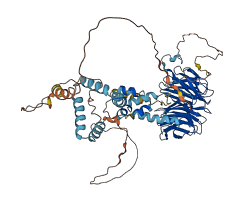
Autoinhibited structure

Activated structure
1 structures for A2QCU8
| Entry ID | Method | Resolution | Chain | Position | Source |
|---|---|---|---|---|---|
| AF-A2QCU8-F1 | Predicted | AlphaFoldDB |
No variants for A2QCU8
| Variant ID(s) | Position | Change | Description | Diseaes Association | Provenance |
|---|---|---|---|---|---|
| No variants for A2QCU8 | |||||
No associated diseases with A2QCU8
9 regional properties for A2QCU8
| Type | Name | Position | InterPro Accession |
|---|---|---|---|
| repeat | WD40 repeat | 330 - 449 | IPR001680-1 |
| repeat | WD40 repeat | 449 - 670 | IPR001680-2 |
| domain | F-box domain | 163 - 210 | IPR001810 |
| conserved_site | WD40 repeat, conserved site | 354 - 368 | IPR019775-1 |
| conserved_site | WD40 repeat, conserved site | 434 - 448 | IPR019775-2 |
| conserved_site | WD40 repeat, conserved site | 475 - 489 | IPR019775-3 |
| repeat | G-protein beta WD-40 repeat | 354 - 368 | IPR020472-1 |
| repeat | G-protein beta WD-40 repeat | 434 - 448 | IPR020472-2 |
| repeat | G-protein beta WD-40 repeat | 614 - 628 | IPR020472-3 |
1 GO annotations of cellular component
| Name | Definition |
|---|---|
| nuclear SCF ubiquitin ligase complex | A ubiquitin ligase complex, located in the nucleus, in which a cullin from the Cul1 subfamily and a RING domain protein form the catalytic core; substrate specificity is conferred by a Skp1 adaptor and an F-box protein. SCF complexes are involved in targeting proteins for degradation by the proteasome. The best characterized complexes are those from yeast and mammals (with core subunits named Cdc53/Cul1, Rbx1/Hrt1/Roc1). |
3 GO annotations of molecular function
| Name | Definition |
|---|---|
| identical protein binding | Binding to an identical protein or proteins. |
| ubiquitin binding | Binding to ubiquitin, a protein that when covalently bound to other cellular proteins marks them for proteolytic degradation. |
| ubiquitin ligase-substrate adaptor activity | The binding activity of a molecule that brings together a ubiquitin ligase and its substrate. Usually mediated by F-box BTB/POZ domain proteins. |
5 GO annotations of biological process
| Name | Definition |
|---|---|
| protein polyubiquitination | Addition of multiple ubiquitin groups to a protein, forming a ubiquitin chain. |
| regulation of transcription involved in G1/S transition of mitotic cell cycle | Any process that regulates transcription such that the target genes are involved in the transition between G1 and S phase of the mitotic cell cycle. |
| response to arsenic-containing substance | Any process that results in a change in state or activity of a cell or an organism (in terms of movement, secretion, enzyme production, gene expression, etc.) as a result of an arsenic stimulus from compounds containing arsenic, including arsenates, arsenites, and arsenides. |
| response to cadmium ion | Any process that results in a change in state or activity of a cell or an organism (in terms of movement, secretion, enzyme production, gene expression, etc.) as a result of a cadmium (Cd) ion stimulus. |
| SCF-dependent proteasomal ubiquitin-dependent protein catabolic process | The chemical reactions and pathways resulting in the breakdown of a protein or peptide by hydrolysis of its peptide bonds, initiated by the covalent attachment of ubiquitin, with ubiquitin-protein ligation catalyzed by an SCF (Skp1/Cul1/F-box protein) complex, and mediated by the proteasome. |
No homologous proteins in AiPD
| UniProt AC | Gene Name | Protein Name | Species | Evidence Code |
|---|---|---|---|---|
| No homologous proteins | ||||
| 10 | 20 | 30 | 40 | 50 | 60 |
| MSSPPPFTSI | FGGPAESAEE | IDADADNSQL | KPHNRSNVTA | TSAKLVGKSV | APFLAKHVPD |
| 70 | 80 | 90 | 100 | 110 | 120 |
| QYAPLGSQNR | EPAALSSANS | RYCYRHRPDR | KCRRQADEPT | MDKLQRELES | LPQSDQQGIA |
| 130 | 140 | 150 | 160 | 170 | 180 |
| HVWSLFSAAP | AKHRKLILQG | IMAQCCFPQL | SFISTTVRDL | IRIDFIAALP | PEISFKILCY |
| 190 | 200 | 210 | 220 | 230 | 240 |
| LDTTSLCKAA | QVSRRWRALA | DDDVVWHRMC | EQHIHRKCKK | CGWGLPLLDR | KRLRESKREI |
| 250 | 260 | 270 | 280 | 290 | 300 |
| EIRATTWDVN | GTSPKATPAL | PEDASPVADS | SGTGKRKPEP | SEEETAVVKR | HCQSLAMRPE |
| 310 | 320 | 330 | 340 | 350 | 360 |
| GSEDYFKTRY | RPWKEVYKDR | FKVGTNWKYG | RCSIRIFKGH | TNGVMCLQFE | DNILATGSYD |
| 370 | 380 | 390 | 400 | 410 | 420 |
| ATIKIWDTDT | GQEIRTLRGH | ESGIRCLQFD | DTKLISGSMD | GSVKVWNWRT | GDCISTYTGH |
| 430 | 440 | 450 | 460 | 470 | 480 |
| RGGVIGLHFD | ATILASASVD | KTVKIWNFED | KSTCLLRGHT | DWVNAVRVDT | ASRTVFSASD |
| 490 | 500 | 510 | 520 | 530 | 540 |
| DCTVRLWDLD | TKSCIRTFHG | HVGQVQQVVP | LPREFEFEEH | DVECENDNLS | TVSGDTEPAS |
| 550 | 560 | 570 | 580 | 590 | 600 |
| LQATLGLESN | AVISQSSPFG | PSFESGRTAP | PRYIVTSALD | STIRLWETST | GRCLRTFFGH |
| 610 | 620 | 630 | 640 | 650 | 660 |
| LEGVWALAAD | TLRIVSGAED | RMIKIWDPRT | GKCERTFTGH | SGPVTCIGLG | DSRFATGSED |
| CEVRMYSFQS |