A2PZA5
Gene name |
PaFS |
Protein name |
Fusicoccadiene synthase |
Names |
FS, Fusicoccin A biosynthetic gene clusters protein 1, PaDC4:GGS |
Species |
Phomopsis amygdali (Fusicoccum amygdali) |
KEGG Pathway |
ag:BAF45924 |
EC number |
2.5.1.29: Transferring alkyl or aryl groups, other than methyl groups |
Protein Class |
|
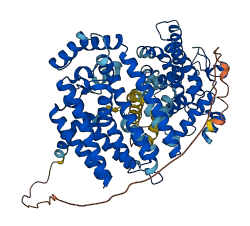
Descriptions
The autoinhibited protein was predicted that may have potential autoinhibitory elements via cis-regPred.
Autoinhibitory domains (AIDs)
Target domain |
|
Relief mechanism |
|
Assay |
cis-regPred |
Accessory elements
No accessory elements
Autoinhibited structure

Activated structure
7 structures for A2PZA5
No variants for A2PZA5
| Variant ID(s) | Position | Change | Description | Diseaes Association | Provenance |
|---|---|---|---|---|---|
| No variants for A2PZA5 | |||||
No associated diseases with A2PZA5
Functions
| Description | ||
|---|---|---|
| EC Number | 2.5.1.29 | Transferring alkyl or aryl groups, other than methyl groups |
| Subcellular Localization |
|
|
| PANTHER Family | ||
| PANTHER Subfamily | ||
| PANTHER Protein Class | ||
| PANTHER Pathway Category | No pathway information available | |
No GO annotations of cellular component
| Name | Definition |
|---|---|
| No GO annotations for cellular component |
3 GO annotations of molecular function
| Name | Definition |
|---|---|
| farnesyltranstransferase activity | Catalysis of the reaction: 2-trans,6-trans-farnesyl diphosphate + isopentenyl diphosphate = diphosphate + geranylgeranyl diphosphate. |
| lyase activity | Catalysis of the cleavage of C-C, C-O, C-N and other bonds by other means than by hydrolysis or oxidation, or conversely adding a group to a double bond. They differ from other enzymes in that two substrates are involved in one reaction direction, but only one in the other direction. When acting on the single substrate, a molecule is eliminated and this generates either a new double bond or a new ring. |
| metal ion binding | Binding to a metal ion. |
1 GO annotations of biological process
| Name | Definition |
|---|---|
| isoprenoid biosynthetic process | The chemical reactions and pathways resulting in the formation of an isoprenoid compound, isoprene (2-methylbuta-1,3-diene) or compounds containing or derived from linked isoprene (3-methyl-2-butenylene) residues. |
No homologous proteins in AiPD
| UniProt AC | Gene Name | Protein Name | Species | Evidence Code |
|---|---|---|---|---|
| No homologous proteins | ||||
| 10 | 20 | 30 | 40 | 50 | 60 |
| MEFKYSEVVE | PSTYYTEGLC | EGIDVRKSKF | TTLEDRGAIR | AHEDWNKHIG | PCGEYRGTLG |
| 70 | 80 | 90 | 100 | 110 | 120 |
| PRFSFISVAV | PECIPERLEV | ISYANEFAFL | HDDVTDHVGH | DTGEVENDEM | MTVFLEAAHT |
| 130 | 140 | 150 | 160 | 170 | 180 |
| GAIDTSNKVD | IRRAGKKRIQ | SQLFLEMLAI | DPECAKTTMK | SWARFVEVGS | SRQHETRFVE |
| 190 | 200 | 210 | 220 | 230 | 240 |
| LAKYIPYRIM | DVGEMFWFGL | VTFGLGLHIP | DHELELCREL | MANAWIAVGL | QNDIWSWPKE |
| 250 | 260 | 270 | 280 | 290 | 300 |
| RDAATLHGKD | HVVNAIWVLM | QEHQTDVDGA | MQICRKLIVE | YVAKYLEVIE | ATKNDESISL |
| 310 | 320 | 330 | 340 | 350 | 360 |
| DLRKYLDAML | YSISGNVVWS | LECPRYNPDV | SFNKTQLEWM | RQGLPSLESC | PVLARSPEID |
| 370 | 380 | 390 | 400 | 410 | 420 |
| SDESAVSPTA | DESDSTEDSL | GSGSRQDSSL | STGLSLSPVH | SNEGKDLQRV | DTDHIFFEKA |
| 430 | 440 | 450 | 460 | 470 | 480 |
| VLEAPYDYIA | SMPSKGVRDQ | FIDALNDWLR | VPDVKVGKIK | DAVRVLHNSS | LLLDDFQDNS |
| 490 | 500 | 510 | 520 | 530 | 540 |
| PLRRGKPSTH | NIFGSAQTVN | TATYSIIKAI | GQIMEFSAGE | SVQEVMNSIM | ILFQGQAMDL |
| 550 | 560 | 570 | 580 | 590 | 600 |
| FWTYNGHVPS | EEEYYRMIDQ | KTGQLFSIAT | SLLLNAADNE | IPRTKIQSCL | HRLTRLLGRC |
| 610 | 620 | 630 | 640 | 650 | 660 |
| FQIRDDYQNL | VSADYTKQKG | FCEDLDEGKW | SLALIHMIHK | QRSHMALLNV | LSTGRKHGGM |
| 670 | 680 | 690 | 700 | 710 | |
| TLEQKQFVLD | IIEEEKSLDY | TRSVMMDLHV | QLRAEIGRIE | ILLDSPNPAM | RLLLELLRV |