A2BVI1
Gene name |
tal |
Protein name |
Transaldolase |
Names |
|
Species |
Prochlorococcus marinus (strain MIT 9515) |
KEGG Pathway |
pmc:P9515_05831 |
EC number |
2.2.1.2: Transketolases and transaldolases |
Protein Class |
|
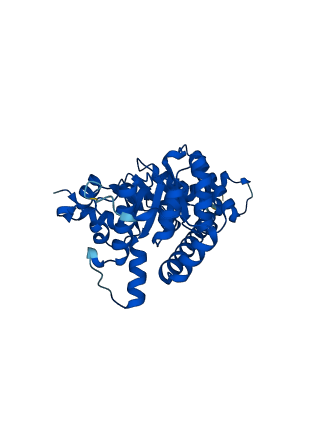
Descriptions
The autoinhibited protein was predicted that may have potential autoinhibitory elements via cis-regPred.
Autoinhibitory domains (AIDs)
Target domain |
|
Relief mechanism |
|
Assay |
cis-regPred |
Accessory elements
No accessory elements
Autoinhibited structure

Activated structure
1 structures for A2BVI1
| Entry ID | Method | Resolution | Chain | Position | Source |
|---|---|---|---|---|---|
| AF-A2BVI1-F1 | Predicted | AlphaFoldDB |
No variants for A2BVI1
| Variant ID(s) | Position | Change | Description | Diseaes Association | Provenance |
|---|---|---|---|---|---|
| No variants for A2BVI1 | |||||
No associated diseases with A2BVI1
2 regional properties for A2BVI1
| Type | Name | Position | InterPro Accession |
|---|---|---|---|
| active_site | Transaldolase, active site | 31 - 39 | IPR018225-1 |
| active_site | Transaldolase, active site | 132 - 149 | IPR018225-2 |
Functions
| Description | ||
|---|---|---|
| EC Number | 2.2.1.2 | Transketolases and transaldolases |
| Subcellular Localization |
|
|
| PANTHER Family | ||
| PANTHER Subfamily | ||
| PANTHER Protein Class | ||
| PANTHER Pathway Category | No pathway information available | |
1 GO annotations of cellular component
| Name | Definition |
|---|---|
| cytoplasm | The contents of a cell excluding the plasma membrane and nucleus, but including other subcellular structures. |
1 GO annotations of molecular function
| Name | Definition |
|---|---|
| transaldolase activity | Catalysis of the reaction: sedoheptulose 7-phosphate + D-glyceraldehyde 3-phosphate = D-erythrose 4-phosphate + D-fructose 6-phosphate. |
2 GO annotations of biological process
| Name | Definition |
|---|---|
| carbohydrate metabolic process | The chemical reactions and pathways involving carbohydrates, any of a group of organic compounds based of the general formula Cx(H2O)y. |
| pentose-phosphate shunt | The metabolic process in which glucose-6-phosphate is oxidized to form carbon dioxide (CO2) and ribulose 5-phosphate, coupled to reduction of NADP+ to NADPH; ribulose 5-P then enters a series of reactions that can yield biosynthetic precursors (ribose-5-phosphate and erythrose-4-phosphate) and glycolytic intermediates (fructose-6-phosphate and glyceraldehyde-3-phosphate). |
No homologous proteins in AiPD
| UniProt AC | Gene Name | Protein Name | Species | Evidence Code |
|---|---|---|---|---|
| No homologous proteins | ||||
| 10 | 20 | 30 | 40 | 50 | 60 |
| MKSILEQLSS | ITTVVADTGD | LDAIKKFQPR | DATTNPSLIL | AAAKNPDYVK | LIDQSLESSR |
| 70 | 80 | 90 | 100 | 110 | 120 |
| KSLPNGVSES | ELIKEAIDQV | SVFFGKEILN | LISGRVSTEV | DARLSFDTDA | TVKKARKLIN |
| 130 | 140 | 150 | 160 | 170 | 180 |
| HYKSFGIDKE | RILIKIASTW | EGIKAAEILE | KEGIRCNLTL | LFNFCQAVAC | ANAKITLISP |
| 190 | 200 | 210 | 220 | 230 | 240 |
| FVGRILDWHK | VKTGKDNFSG | KEDPGVISVT | KIYNYFKEKG | FKTEVMGASF | RNVDEIKELA |
| 250 | 260 | 270 | 280 | 290 | 300 |
| GCDLLTIAPK | FLDELSKEEG | ELIKKLDENI | QSKSSIDYEF | DEKDFRLSML | EDQMASEKLS |
| 310 | 320 | 330 | |||
| EGITGFSKAI | EELEELLLKR | FSEINNQKLI | SAT |