A2AQ14
Gene name |
Oip5 (Ms18b) |
Protein name |
Protein Mis18-beta |
Names |
Opa-interacting protein 5 homolog |
Species |
Mus musculus (Mouse) |
KEGG Pathway |
mmu:70645 |
EC number |
|
Protein Class |
|
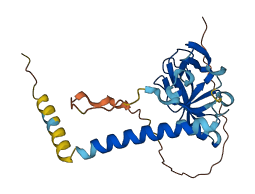
Descriptions
The autoinhibited protein was predicted that may have potential autoinhibitory elements via cis-regPred.
Autoinhibitory domains (AIDs)
Target domain |
|
Relief mechanism |
|
Assay |
cis-regPred |
Accessory elements
No accessory elements
Autoinhibited structure

Activated structure
1 structures for A2AQ14
| Entry ID | Method | Resolution | Chain | Position | Source |
|---|---|---|---|---|---|
| AF-A2AQ14-F1 | Predicted | AlphaFoldDB |
11 variants for A2AQ14
| Variant ID(s) | Position | Change | Description | Diseaes Association | Provenance |
|---|---|---|---|---|---|
| rs3388583865 | 5 | S>* | No | EVA | |
| rs33757472 | 17 | R>H | No | EVA | |
| rs239749708 | 18 | R>C | No | EVA | |
| rs239749708 | 18 | R>G | No | EVA | |
| rs33563936 | 45 | G>V | No | EVA | |
| rs1133466278 | 78 | Y>* | No | EVA | |
| rs216604185 | 120 | F>S | No | EVA | |
| rs3388575180 | 217 | H>Y | No | EVA | |
| rs259162847 | 218 | Q>K | No | EVA | |
| rs27440514 | 219 | F>S | No | EVA | |
| rs225784983 | 237 | S>* | No | EVA |
No associated diseases with A2AQ14
Functions
7 GO annotations of cellular component
| Name | Definition |
|---|---|
| Cajal body | A class of nuclear body, first seen after silver staining by Ramon y Cajal in 1903, enriched in small nuclear ribonucleoproteins, and certain general RNA polymerase II transcription factors; ultrastructurally, they appear as a tangle of coiled, electron-dense threads roughly 0.5 micrometers in diameter; involved in aspects of snRNP biogenesis; the protein coilin serves as a marker for Cajal bodies. Some argue that Cajal bodies are the sites for preassembly of transcriptosomes, unitary particles involved in transcription and processing of RNA. |
| chromatin | The ordered and organized complex of DNA, protein, and sometimes RNA, that forms the chromosome. |
| chromocenter | A region in which centric, heterochromatic portions from more than one chromosomes form a compact structure. |
| chromosome, centromeric region | The region of a chromosome that includes the centromeric DNA and associated proteins. In monocentric chromosomes, this region corresponds to a single area of the chromosome, whereas in holocentric chromosomes, it is evenly distributed along the chromosome. |
| intracellular membrane-bounded organelle | Organized structure of distinctive morphology and function, bounded by a single or double lipid bilayer membrane and occurring within the cell. Includes the nucleus, mitochondria, plastids, vacuoles, and vesicles. Excludes the plasma membrane. |
| nuclear speck | A discrete extra-nucleolar subnuclear domain, 20-50 in number, in which splicing factors are seen to be localized by immunofluorescence microscopy. |
| nucleus | A membrane-bounded organelle of eukaryotic cells in which chromosomes are housed and replicated. In most cells, the nucleus contains all of the cell's chromosomes except the organellar chromosomes, and is the site of RNA synthesis and processing. In some species, or in specialized cell types, RNA metabolism or DNA replication may be absent. |
2 GO annotations of molecular function
| Name | Definition |
|---|---|
| identical protein binding | Binding to an identical protein or proteins. |
| metal ion binding | Binding to a metal ion. |
4 GO annotations of biological process
| Name | Definition |
|---|---|
| cell cycle | The progression of biochemical and morphological phases and events that occur in a cell during successive cell replication or nuclear replication events. Canonically, the cell cycle comprises the replication and segregation of genetic material followed by the division of the cell, but in endocycles or syncytial cells nuclear replication or nuclear division may not be followed by cell division. |
| cell division | The process resulting in division and partitioning of components of a cell to form more cells; may or may not be accompanied by the physical separation of a cell into distinct, individually membrane-bounded daughter cells. |
| CENP-A containing chromatin assembly | The formation of chromatin containing the histone H3 variant CENP-A to form centromeric chromatin. This specialised chromatin occurs at centromeric region in point centromeres, and the central core in modular centromeres. |
| chromosome segregation | The process in which genetic material, in the form of chromosomes, is organized into specific structures and then physically separated and apportioned to two or more sets. In eukaryotes, chromosome segregation begins with the condensation of chromosomes, includes chromosome separation, and ends when chromosomes have completed movement to the spindle poles. |
No homologous proteins in AiPD
| UniProt AC | Gene Name | Protein Name | Species | Evidence Code |
|---|---|---|---|---|
| No homologous proteins | ||||
| 10 | 20 | 30 | 40 | 50 | 60 |
| MATLSRRSLR | FLETQSRRDS | CDTPFSLTSS | MEWDTQVVEG | FSPLGSSESK | VKASPVDLRL |
| 70 | 80 | 90 | 100 | 110 | 120 |
| PAWLEPERCA | VFHCARCYAV | LGDTLHLAWD | LSRSLGALAF | SKVTNNVVLL | EPFLVGIEGF |
| 130 | 140 | 150 | 160 | 170 | 180 |
| LKSSTYNLLF | CNSCGTPVGF | HLYSTHAAMA | ALRGHFCLSS | DKMLCYLLKT | NAIVNTSEMD |
| 190 | 200 | 210 | 220 | 230 | 240 |
| FHNVPLPEKI | AELKEKIMLM | HTRLNSLTGL | LKGKSPHQFK | QENQQARKQH | ILGLTASPKI |
| L |