A2A1A0
Gene name |
NCS1 |
Protein name |
S-norcoclaurine synthase 1 |
Names |
CjNCS1 |
Species |
Coptis japonica (Japanese goldthread) |
KEGG Pathway |
|
EC number |
4.2.1.78: Hydro-lyases |
Protein Class |
|
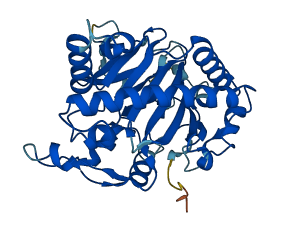
Descriptions
The autoinhibited protein was predicted that may have potential autoinhibitory elements via cis-regPred.
Autoinhibitory domains (AIDs)
Target domain |
|
Relief mechanism |
|
Assay |
cis-regPred |
Accessory elements
No accessory elements
Autoinhibited structure

Activated structure
1 structures for A2A1A0
| Entry ID | Method | Resolution | Chain | Position | Source |
|---|---|---|---|---|---|
| AF-A2A1A0-F1 | Predicted | AlphaFoldDB |
No variants for A2A1A0
| Variant ID(s) | Position | Change | Description | Diseaes Association | Provenance |
|---|---|---|---|---|---|
| No variants for A2A1A0 | |||||
No associated diseases with A2A1A0
Functions
| Description | ||
|---|---|---|
| EC Number | 4.2.1.78 | Hydro-lyases |
| Subcellular Localization |
|
|
| PANTHER Family | ||
| PANTHER Subfamily | ||
| PANTHER Protein Class | ||
| PANTHER Pathway Category | No pathway information available | |
No GO annotations of cellular component
| Name | Definition |
|---|---|
| No GO annotations for cellular component |
3 GO annotations of molecular function
| Name | Definition |
|---|---|
| (S)-norcoclaurine synthase activity | Catalysis of the reaction: 4-(2-aminoethyl)benzene-1,2-diol + 4-hydroxyphenylacetaldehyde = (S)-norcoclaurine + H2O. |
| metal ion binding | Binding to a metal ion. |
| oxidoreductase activity | Catalysis of an oxidation-reduction (redox) reaction, a reversible chemical reaction in which the oxidation state of an atom or atoms within a molecule is altered. One substrate acts as a hydrogen or electron donor and becomes oxidized, while the other acts as hydrogen or electron acceptor and becomes reduced. |
1 GO annotations of biological process
| Name | Definition |
|---|---|
| alkaloid metabolic process | The chemical reactions and pathways involving alkaloids, nitrogen containing natural products which are not otherwise classified as peptides, nonprotein amino acids, amines, cyanogenic glycosides, glucosinolates, cofactors, phytohormones or primary metabolites (such as purine or pyrimidine bases). |
No homologous proteins in AiPD
| UniProt AC | Gene Name | Protein Name | Species | Evidence Code |
|---|---|---|---|---|
| No homologous proteins | ||||
| 10 | 20 | 30 | 40 | 50 | 60 |
| MSKNLTGVGG | SLPVENVQVL | AGKELKNLPN | RYVRPELEHD | DVVPIDNSLE | IPVIDLSRLL |
| 70 | 80 | 90 | 100 | 110 | 120 |
| DQQYACDELA | KFHSACLDWG | FFQLINHGVR | EEVIEKMKVD | TEDFFRLPFK | EKNAYRQLPN |
| 130 | 140 | 150 | 160 | 170 | 180 |
| GMEGYGQAFV | TSEEQKLDWA | DMHFLITKPV | QERNMRFWPT | SPTSFRETME | KYSMELQKVA |
| 190 | 200 | 210 | 220 | 230 | 240 |
| MCLTGMMAKN | LGLESEILTK | PLRTVFNRED | ELLPSMSSCG | EGLGLSPHSD | ATGLTLLIQV |
| 250 | 260 | 270 | 280 | 290 | 300 |
| NEVNGLHIKK | DEKWVPIKPI | LGAFVVNIGD | VIEIMSNGIY | KSIEHRAVIN | TDKERLSIAA |
| 310 | 320 | 330 | 340 | 350 | |
| FHDPEYGTKI | GPLPDLVKEN | GVKYKTIDYE | DYLIRSSNIK | LDGKSLLDQM | KL |