A1YQ91
Gene name |
ODAM (APIN) |
Protein name |
Odontogenic ameloblast-associated protein |
Names |
Apin |
Species |
Canis lupus familiaris (Dog) (Canis familiaris) |
KEGG Pathway |
cfa:611755 |
EC number |
|
Protein Class |
|
Descriptions
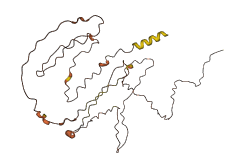
The autoinhibited protein was predicted that may have potential autoinhibitory elements via cis-regPred.
Autoinhibitory domains (AIDs)
Target domain |
|
Relief mechanism |
|
Assay |
cis-regPred |
Accessory elements
No accessory elements
Autoinhibited structure

Activated structure
1 structures for A1YQ91
| Entry ID | Method | Resolution | Chain | Position | Source |
|---|---|---|---|---|---|
| AF-A1YQ91-F1 | Predicted | AlphaFoldDB |
2 variants for A1YQ91
| Variant ID(s) | Position | Change | Description | Diseaes Association | Provenance |
|---|---|---|---|---|---|
| rs852448125 | 85 | G>A | No | EVA | |
| rs852763434 | 102 | G>A | No | EVA |
No associated diseases with A1YQ91
No regional properties for A1YQ91
| Type | Name | Position | InterPro Accession |
|---|---|---|---|
| No domain, repeats, and functional sites for A1YQ91 | |||
8 GO annotations of cellular component
| Name | Definition |
|---|---|
| cell periphery | The part of a cell encompassing the cell cortex, the plasma membrane, and any external encapsulating structures. |
| cytoplasm | The contents of a cell excluding the plasma membrane and nucleus, but including other subcellular structures. |
| cytosol | The part of the cytoplasm that does not contain organelles but which does contain other particulate matter, such as protein complexes. |
| extracellular space | That part of a multicellular organism outside the cells proper, usually taken to be outside the plasma membranes, and occupied by fluid. |
| mitotic spindle | A spindle that forms as part of mitosis. Mitotic and meiotic spindles contain distinctive complements of proteins associated with microtubules. |
| nucleoplasm | That part of the nuclear content other than the chromosomes or the nucleolus. |
| nucleus | A membrane-bounded organelle of eukaryotic cells in which chromosomes are housed and replicated. In most cells, the nucleus contains all of the cell's chromosomes except the organellar chromosomes, and is the site of RNA synthesis and processing. In some species, or in specialized cell types, RNA metabolism or DNA replication may be absent. |
| supramolecular fiber | A polymer consisting of an indefinite number of protein or protein complex subunits that have polymerised to form a fiber-shaped structure. |
No GO annotations of molecular function
| Name | Definition |
|---|---|
| No GO annotations for molecular function |
8 GO annotations of biological process
| Name | Definition |
|---|---|
| biomineral tissue development | Formation of hard tissues that consist mainly of inorganic compounds, and also contain a small amounts of organic matrices that are believed to play important roles in their formation. |
| inflammatory response | The immediate defensive reaction (by vertebrate tissue) to infection or injury caused by chemical or physical agents. The process is characterized by local vasodilation, extravasation of plasma into intercellular spaces and accumulation of white blood cells and macrophages. |
| odontogenesis of dentin-containing tooth | The process whose specific outcome is the progression of a dentin-containing tooth over time, from its formation to the mature structure. A dentin-containing tooth is a hard, bony organ borne on the jaw or other bone of a vertebrate, and is composed mainly of dentin, a dense calcified substance, covered by a layer of enamel. |
| positive regulation of epithelial cell proliferation involved in wound healing | Any process that activates or increases the rate or extent of epithelial cell proliferation, contributing to the restoration of integrity to a damaged tissue following an injury. |
| positive regulation of gene expression | Any process that increases the frequency, rate or extent of gene expression. Gene expression is the process in which a gene's coding sequence is converted into a mature gene product (protein or RNA). |
| positive regulation of GTPase activity | Any process that activates or increases the activity of a GTPase. |
| positive regulation of protein phosphorylation | Any process that activates or increases the frequency, rate or extent of addition of phosphate groups to amino acids within a protein. |
| regulation of actin cytoskeleton organization | Any process that modulates the frequency, rate or extent of the formation, arrangement of constituent parts, or disassembly of cytoskeletal structures comprising actin filaments and their associated proteins. |
No homologous proteins in AiPD
| UniProt AC | Gene Name | Protein Name | Species | Evidence Code |
|---|---|---|---|---|
| No homologous proteins | ||||
| 10 | 20 | 30 | 40 | 50 | 60 |
| MKTIILLGLL | GATMSAPLIP | QRLMSASNSN | ELLLNLNNAQ | LQPLPFQGPF | NSWIPPFSGI |
| 70 | 80 | 90 | 100 | 110 | 120 |
| LQQQQQAQIP | GLSQFSLSAL | DRFAGLFPNQ | TPFPGRVSFA | QGTQVGQQDP | SQPQTPPQTQ |
| 130 | 140 | 150 | 160 | 170 | 180 |
| QSPNHVMPYV | FSFKMPQEQA | QMLQYYPVYM | LLPWEQSQQT | APQSPPQTGQ | QQFEEQMPFY |
| 190 | 200 | 210 | 220 | 230 | 240 |
| TQFGYVPVQV | EPVMPGGQQQ | LALDPVLGTA | PETVVMPAGV | IPYLRKEVIN | FKHANGGIFV |
| 250 | 260 | 270 | |||
| PSTSQTPSTT | NYFAPAIDPT | ITPELMEKKA | KTDYLKEP |