A1TZT8
Gene name |
zipA |
Protein name |
Cell division protein ZipA |
Names |
|
Species |
Marinobacter nauticus (strain ATCC 700491 / DSM 11845 / VT8) (Marinobacter aquaeolei) |
KEGG Pathway |
maq:Maqu_1166 |
EC number |
|
Protein Class |
|
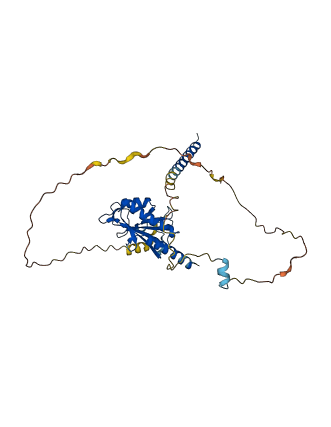
Descriptions
The autoinhibited protein was predicted that may have potential autoinhibitory elements via cis-regPred.
Autoinhibitory domains (AIDs)
Target domain |
|
Relief mechanism |
|
Assay |
cis-regPred |
Accessory elements
No accessory elements
Autoinhibited structure

Activated structure
1 structures for A1TZT8
| Entry ID | Method | Resolution | Chain | Position | Source |
|---|---|---|---|---|---|
| AF-A1TZT8-F1 | Predicted | AlphaFoldDB |
No variants for A1TZT8
| Variant ID(s) | Position | Change | Description | Diseaes Association | Provenance |
|---|---|---|---|---|---|
| No variants for A1TZT8 | |||||
3 associated diseases with A1TZT8
[MIM: 163800]: Sick sinus syndrome 2 (SSS2)
The term 'sick sinus syndrome' encompasses a variety of conditions caused by sinus node dysfunction. The most common clinical manifestations are syncope, presyncope, dizziness, and fatigue. Electrocardiogram typically shows sinus bradycardia, sinus arrest, and/or sinoatrial block. Episodes of atrial tachycardias coexisting with sinus bradycardia ('tachycardia-bradycardia syndrome') are also common in this disorder. SSS occurs most often in the elderly associated with underlying heart disease or previous cardiac surgery, but can also occur in the fetus, infant, or child without heart disease or other contributing factors. SSS2 onset is in utero or at birth. . Note=The disease is caused by variants affecting the gene represented in this entry.
[MIM: 613123]: Brugada syndrome 8 (BRGDA8)
A tachyarrhythmia characterized by right bundle branch block and ST segment elevation on an electrocardiogram (ECG). It can cause the ventricles to beat so fast that the blood is prevented from circulating efficiently in the body. When this situation occurs, the individual will faint and may die in a few minutes if the heart is not reset. . Note=The gene represented in this entry may be involved in disease pathogenesis.
[MIM: 619521]: Epilepsy, idiopathic generalized 18 (EIG18)
An autosomal dominant form of idiopathic generalized epilepsy, a disorder characterized by recurring generalized seizures in the absence of detectable brain lesions and/or metabolic abnormalities. Generalized seizures arise diffusely and simultaneously from both hemispheres of the brain. Seizure types include juvenile myoclonic seizures, absence seizures, and generalized tonic-clonic seizures. EIG18 is characterized by onset of myoclonic seizures in infancy. Although the seizures remit, some patients may have later speech or cognitive impairment. . Note=Disease susceptibility is associated with variants affecting the gene represented in this entry.
Without disease ID
- The term 'sick sinus syndrome' encompasses a variety of conditions caused by sinus node dysfunction. The most common clinical manifestations are syncope, presyncope, dizziness, and fatigue. Electrocardiogram typically shows sinus bradycardia, sinus arrest, and/or sinoatrial block. Episodes of atrial tachycardias coexisting with sinus bradycardia ('tachycardia-bradycardia syndrome') are also common in this disorder. SSS occurs most often in the elderly associated with underlying heart disease or previous cardiac surgery, but can also occur in the fetus, infant, or child without heart disease or other contributing factors. SSS2 onset is in utero or at birth. . Note=The disease is caused by variants affecting the gene represented in this entry.
- A tachyarrhythmia characterized by right bundle branch block and ST segment elevation on an electrocardiogram (ECG). It can cause the ventricles to beat so fast that the blood is prevented from circulating efficiently in the body. When this situation occurs, the individual will faint and may die in a few minutes if the heart is not reset. . Note=The gene represented in this entry may be involved in disease pathogenesis.
- An autosomal dominant form of idiopathic generalized epilepsy, a disorder characterized by recurring generalized seizures in the absence of detectable brain lesions and/or metabolic abnormalities. Generalized seizures arise diffusely and simultaneously from both hemispheres of the brain. Seizure types include juvenile myoclonic seizures, absence seizures, and generalized tonic-clonic seizures. EIG18 is characterized by onset of myoclonic seizures in infancy. Although the seizures remit, some patients may have later speech or cognitive impairment. . Note=Disease susceptibility is associated with variants affecting the gene represented in this entry.
2 GO annotations of cellular component
| Name | Definition |
|---|---|
| cell division site | The eventual plane of cell division (also known as cell cleavage or cytokinesis) in a dividing cell. In Eukaryotes, the cleavage apparatus, composed of septin structures and the actomyosin contractile ring, forms along this plane, and the mitotic, or meiotic, spindle is aligned perpendicular to the division plane. In bacteria, the cell division site is generally located at mid-cell and is the site at which the cytoskeletal structure, the Z-ring, assembles. |
| integral component of plasma membrane | The component of the plasma membrane consisting of the gene products and protein complexes having at least some part of their peptide sequence embedded in the hydrophobic region of the membrane. |
No GO annotations of molecular function
| Name | Definition |
|---|---|
| No GO annotations for molecular function |
2 GO annotations of biological process
| Name | Definition |
|---|---|
| cell septum assembly | The assembly and arrangement of a cellular component that is composed of peptidoglycan and often chitin in addition to other materials and usually forms perpendicular to the long axis of a cell or hypha. It grows centripetally from the cell wall to the center of the cell and often functions in the compartmentalization of a cell into two daughter cells. |
| FtsZ-dependent cytokinesis | A cytokinesis process that involves a set of conserved proteins including FtsZ, and results in the formation of two similarly sized and shaped cells. |
No homologous proteins in AiPD
| UniProt AC | Gene Name | Protein Name | Species | Evidence Code |
|---|---|---|---|---|
| No homologous proteins | ||||
| 10 | 20 | 30 | 40 | 50 | 60 |
| MSLREWLIAI | GTLVIIGIVI | DGVRRMRRAR | KESMAISSGM | GADELKDSPL | DDDFNPELPN |
| 70 | 80 | 90 | 100 | 110 | 120 |
| GGARTVSRST | LEDRGYLKRD | MSAPVSTDQE | DDVTPESGWS | ARDDDEDDGI | LSPPRVVKPE |
| 130 | 140 | 150 | 160 | 170 | 180 |
| TEESEPVEPE | AVKTPATEVD | RSKTRPSVPE | KAKAEPEPRA | EEPPVVTTEV | EEDTARRTPN |
| 190 | 200 | 210 | 220 | 230 | 240 |
| KPRKNQPLAG | ANRPEAREVL | VINVLARSGE | QFQGSKLKSL | FEACGLEQGD | MDIYHRHESE |
| 250 | 260 | 270 | 280 | 290 | 300 |
| DTTTPVQFSV | ANAVEPGTFR | PQDMAGLSTP | GISFFMSLPG | PTNALQAFEF | MLETAQCVVR |
| 310 | 320 | 330 | |||
| NLGGELKDER | RSVMTPQTIE | HCRQRIREFE | RKQRSQRA |