A1KMN3
Gene name |
tsf |
Protein name |
Elongation factor Ts |
Names |
EF-Ts |
Species |
Mycobacterium bovis (strain BCG / Pasteur 1173P2) |
KEGG Pathway |
mbb:BCG_2910c |
EC number |
|
Protein Class |
|
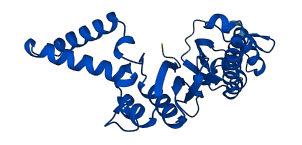
Descriptions
The autoinhibited protein was predicted that may have potential autoinhibitory elements via cis-regPred.
Autoinhibitory domains (AIDs)
Target domain |
|
Relief mechanism |
|
Assay |
cis-regPred |
Accessory elements
No accessory elements
Autoinhibited structure

Activated structure
1 structures for A1KMN3
| Entry ID | Method | Resolution | Chain | Position | Source |
|---|---|---|---|---|---|
| AF-A1KMN3-F1 | Predicted | AlphaFoldDB |
No variants for A1KMN3
| Variant ID(s) | Position | Change | Description | Diseaes Association | Provenance |
|---|---|---|---|---|---|
| No variants for A1KMN3 | |||||
1 associated diseases with A1KMN3
[MIM: 619534]: Biliary, renal, neurologic, and skeletal syndrome (BRENS)
An autosomal recessive ciliopathy with multisystemic manifestations including severe neonatal cholestasis that progresses to liver fibrosis and cirrhosis, postaxial polydactyly, hydrocephalus, retinal abnormalities, and situs inversus. Additional features may include congenital cardiac defects, echogenic kidneys with renal failure, ocular abnormalities, joint hyperextensibility, and dysmorphic facial features. Some patients have global developmental delay. Brain imaging typically shows dilated ventricles, hypomyelination, and white matter abnormalities, although some patients have been described with abnormal pituitary development. {ECO:0000269|PubMed:31595528, ECO:0000269|PubMed:32617964}. Note=The disease is caused by variants affecting the gene represented in this entry.
Without disease ID
- An autosomal recessive ciliopathy with multisystemic manifestations including severe neonatal cholestasis that progresses to liver fibrosis and cirrhosis, postaxial polydactyly, hydrocephalus, retinal abnormalities, and situs inversus. Additional features may include congenital cardiac defects, echogenic kidneys with renal failure, ocular abnormalities, joint hyperextensibility, and dysmorphic facial features. Some patients have global developmental delay. Brain imaging typically shows dilated ventricles, hypomyelination, and white matter abnormalities, although some patients have been described with abnormal pituitary development. {ECO:0000269|PubMed:31595528, ECO:0000269|PubMed:32617964}. Note=The disease is caused by variants affecting the gene represented in this entry.
5 regional properties for A1KMN3
| Type | Name | Position | InterPro Accession |
|---|---|---|---|
| repeat | Tetratricopeptide repeat | 57 - 90 | IPR019734-1 |
| repeat | Tetratricopeptide repeat | 91 - 124 | IPR019734-2 |
| repeat | Tetratricopeptide repeat | 151 - 184 | IPR019734-3 |
| repeat | Tetratricopeptide repeat | 230 - 263 | IPR019734-4 |
| repeat | Tetratricopeptide repeat | 461 - 494 | IPR019734-5 |
1 GO annotations of cellular component
| Name | Definition |
|---|---|
| cytoplasm | The contents of a cell excluding the plasma membrane and nucleus, but including other subcellular structures. |
1 GO annotations of molecular function
| Name | Definition |
|---|---|
| translation elongation factor activity | Functions in chain elongation during polypeptide synthesis at the ribosome. |
No GO annotations of biological process
| Name | Definition |
|---|---|
| No GO annotations for biological process |
No homologous proteins in AiPD
| UniProt AC | Gene Name | Protein Name | Species | Evidence Code |
|---|---|---|---|---|
| No homologous proteins | ||||
| 10 | 20 | 30 | 40 | 50 | 60 |
| MANFTAADVK | RLRELTGAGM | LACKNALAET | DGDFDKAVEA | LRIKGAKDVG | KRAERATAEG |
| 70 | 80 | 90 | 100 | 110 | 120 |
| LVAAKDGALI | ELNCETDFVA | KNAEFQTLAD | QVVAAAAAAK | PADVDALKGA | SIGDKTVEQA |
| 130 | 140 | 150 | 160 | 170 | 180 |
| IAELSAKIGE | KLELRRVAIF | DGTVEAYLHR | RSADLPPAVG | VLVEYRGDDA | AAAHAVALQI |
| 190 | 200 | 210 | 220 | 230 | 240 |
| AALRARYLSR | DDVPEDIVAS | ERRIAEETAR | AEGKPEQALP | KIVEGRLNGF | FKDAVLLEQA |
| 250 | 260 | 270 | |||
| SVSDNKKTVK | ALLDVAGVMV | TRFVRFEVGQ | A |