A1E9X8
Gene name |
ndhI |
Protein name |
NAD(P)H-quinone oxidoreductase subunit I, chloroplastic |
Names |
NAD(P)H dehydrogenase subunit I, NDH subunit I, NADH-plastoquinone oxidoreductase subunit I |
Species |
Sorghum bicolor (Sorghum) (Sorghum vulgare) |
KEGG Pathway |
sbi:4549156 |
EC number |
|
Protein Class |
|
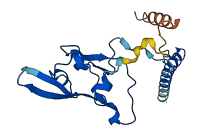
Descriptions
The autoinhibited protein was predicted that may have potential autoinhibitory elements via cis-regPred.
Autoinhibitory domains (AIDs)
Target domain |
|
Relief mechanism |
|
Assay |
cis-regPred |
Accessory elements
No accessory elements
Autoinhibited structure

Activated structure
1 structures for A1E9X8
| Entry ID | Method | Resolution | Chain | Position | Source |
|---|---|---|---|---|---|
| AF-A1E9X8-F1 | Predicted | AlphaFoldDB |
No variants for A1E9X8
| Variant ID(s) | Position | Change | Description | Diseaes Association | Provenance |
|---|---|---|---|---|---|
| No variants for A1E9X8 | |||||
No associated diseases with A1E9X8
1 GO annotations of cellular component
| Name | Definition |
|---|---|
| chloroplast thylakoid membrane | The pigmented membrane of a chloroplast thylakoid. An example of this component is found in Arabidopsis thaliana. |
4 GO annotations of molecular function
| Name | Definition |
|---|---|
| 4 iron, 4 sulfur cluster binding | Binding to a 4 iron, 4 sulfur (4Fe-4S) cluster; this cluster consists of four iron atoms, with the inorganic sulfur atoms found between the irons and acting as bridging ligands. |
| iron ion binding | Binding to an iron (Fe) ion. |
| NADH dehydrogenase (ubiquinone) activity | Catalysis of the reaction: NADH + ubiquinone + 5 H(+)(in) <=> NAD(+) + ubiquinol + 4 H(+)(out). |
| quinone binding | Binding to a quinone, any member of a class of diketones derivable from aromatic compounds by conversion of two CH groups into CO groups with any necessary rearrangement of double bonds. |
1 GO annotations of biological process
| Name | Definition |
|---|---|
| photosynthesis, light reaction | The light reactions of photosynthesis, which take place in photosystems II and I. Light energy is harvested and used to power the transfer of electrons among a series of electron donors and acceptors. The final electron acceptor is NADP+, which is reduced to NADPH. NADPH generated from light reactions is used in sugar synthesis in dark reactions. Light reactions also generate a proton motive force across the thylakoid membrane, and the proton gradient is used to synthesize ATP. There are two chemical reactions involved in the light reactions: water oxidation in photosystem II, and NADP reduction in photosystem I. |
1 homologous proteins in AiPD
| UniProt AC | Gene Name | Protein Name | Species | Evidence Code |
|---|---|---|---|---|
| O00217 | NDUFS8 | NADH dehydrogenase [ubiquinone] iron-sulfur protein 8, mitochondrial | Homo sapiens (Human) | PR |
| 10 | 20 | 30 | 40 | 50 | 60 |
| MFPMLTGFIS | YGQQTIRAAR | YIGQGLIITL | SHTNRLPITI | HYPYEKSITS | ERFRGRIHFE |
| 70 | 80 | 90 | 100 | 110 | 120 |
| FDKCIACEVC | VRVCPIDLPL | VDWKFEKDIK | RKQLLNYSID | FGVCIFCGNC | VEYCPTNCLS |
| 130 | 140 | 150 | 160 | 170 | |
| MTEEYELSTY | DRHELNYNQI | ALSRLPISIM | GDYTIQTIRN | SPQSKIDEEK | SWNSRTITDY |