A1D8G1
Gene name |
dhh1 (NFIA_071760) |
Protein name |
ATP-dependent RNA helicase dhh1 |
Names |
|
Species |
Neosartorya fischeri (strain ATCC 1020 / DSM 3700 / CBS 544.65 / FGSC A1164 / JCM 1740 / NRRL 181 / WB 181) (Aspergillus fischerianus) |
KEGG Pathway |
nfi:NFIA_071760 |
EC number |
3.6.4.13: Acting on ATP; involved in cellular and subcellular movement |
Protein Class |
|
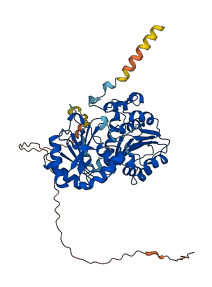
Descriptions
The autoinhibited protein was predicted that may have potential autoinhibitory elements via cis-regPred.
Autoinhibitory domains (AIDs)
Target domain |
|
Relief mechanism |
|
Assay |
cis-regPred |
Accessory elements
No accessory elements
Autoinhibited structure

Activated structure
1 structures for A1D8G1
| Entry ID | Method | Resolution | Chain | Position | Source |
|---|---|---|---|---|---|
| AF-A1D8G1-F1 | Predicted | AlphaFoldDB |
No variants for A1D8G1
| Variant ID(s) | Position | Change | Description | Diseaes Association | Provenance |
|---|---|---|---|---|---|
| No variants for A1D8G1 | |||||
No associated diseases with A1D8G1
5 regional properties for A1D8G1
| Type | Name | Position | InterPro Accession |
|---|---|---|---|
| conserved_site | ATP-dependent RNA helicase DEAD-box, conserved site | 194 - 202 | IPR000629 |
| domain | Helicase, C-terminal | 258 - 418 | IPR001650 |
| domain | DEAD/DEAH box helicase domain | 72 - 231 | IPR011545 |
| domain | Helicase superfamily 1/2, ATP-binding domain | 66 - 262 | IPR014001 |
| domain | RNA helicase, DEAD-box type, Q motif | 47 - 75 | IPR014014 |
Functions
| Description | ||
|---|---|---|
| EC Number | 3.6.4.13 | Acting on ATP; involved in cellular and subcellular movement |
| Subcellular Localization |
|
|
| PANTHER Family | ||
| PANTHER Subfamily | ||
| PANTHER Protein Class | ||
| PANTHER Pathway Category | No pathway information available | |
3 GO annotations of cellular component
| Name | Definition |
|---|---|
| cytoplasmic side of membrane | The side of a membrane that faces the cytoplasm. |
| cytoplasmic stress granule | A dense aggregation in the cytosol composed of proteins and RNAs that appear when the cell is under stress. |
| P-body | A focus in the cytoplasm where mRNAs may become inactivated by decapping or some other mechanism. Protein and RNA localized to these foci are involved in mRNA degradation, nonsense-mediated mRNA decay (NMD), translational repression, and RNA-mediated gene silencing. |
5 GO annotations of molecular function
| Name | Definition |
|---|---|
| ATP binding | Binding to ATP, adenosine 5'-triphosphate, a universally important coenzyme and enzyme regulator. |
| ATP hydrolysis activity | Catalysis of the reaction: ATP + H2O = ADP + H+ phosphate. ATP hydrolysis is used in some reactions as an energy source, for example to catalyze a reaction or drive transport against a concentration gradient. |
| chromatin binding | Binding to chromatin, the network of fibers of DNA, protein, and sometimes RNA, that make up the chromosomes of the eukaryotic nucleus during interphase. |
| mRNA binding | Binding to messenger RNA (mRNA), an intermediate molecule between DNA and protein. mRNA includes UTR and coding sequences, but does not contain introns. |
| RNA helicase activity | Unwinding of an RNA helix, driven by ATP hydrolysis. |
8 GO annotations of biological process
| Name | Definition |
|---|---|
| deadenylation-dependent decapping of nuclear-transcribed mRNA | Cleavage of the 5'-cap of a nuclear mRNA triggered by shortening of the poly(A) tail to below a minimum functional length. |
| mRNA processing | Any process involved in the conversion of a primary mRNA transcript into one or more mature mRNA(s) prior to translation into polypeptide. |
| mRNA transport | The directed movement of mRNA, messenger ribonucleic acid, into, out of or within a cell, or between cells, by means of some agent such as a transporter or pore. |
| negative regulation of translational elongation | Any process that stops, prevents, or reduces the frequency, rate or extent of translational elongation. |
| P-body assembly | The aggregation, arrangement and bonding together of proteins and RNA molecules to form a cytoplasmic mRNA processing body. |
| positive regulation of translation | Any process that activates or increases the frequency, rate or extent of the chemical reactions and pathways resulting in the formation of proteins by the translation of mRNA or circRNA. |
| regulation of cytoplasmic mRNA processing body assembly | Any process that modulates the rate, frequency, or extent of the aggregation, arrangement and bonding together of proteins and RNA molecules to form a cytoplasmic mRNA processing body. |
| stress granule assembly | The aggregation, arrangement and bonding together of proteins and RNA molecules to form a stress granule. |
No homologous proteins in AiPD
| UniProt AC | Gene Name | Protein Name | Species | Evidence Code |
|---|---|---|---|---|
| No homologous proteins | ||||
| 10 | 20 | 30 | 40 | 50 | 60 |
| MADALANQLN | NTSLGEANSE | MRWREQLNMP | AKDARPQTED | VTATKGLEFE | DFYIKRELMM |
| 70 | 80 | 90 | 100 | 110 | 120 |
| GIFEAGFEKP | SPIQEETIPV | ALTGRDILAR | AKNGTGKTAA | FVIPTLERIN | PKSTKTQALI |
| 130 | 140 | 150 | 160 | 170 | 180 |
| LVPTRELALQ | TSQVCKTLGK | HLGINVMVTT | GGTGLMDDII | RLNDAVHILV | GTPGRVLDLA |
| 190 | 200 | 210 | 220 | 230 | 240 |
| SKGVADLSEC | PTFVMDEADK | LLSPEFTPVI | EQLLSFHPKD | RQVMLFSATF | PLIVKSFKDK |
| 250 | 260 | 270 | 280 | 290 | 300 |
| HMRNPYEINL | MDELTLRGIT | QYYAFVEEKQ | KVHCLNTLFS | KLQINQSIIF | CNSTNRVELL |
| 310 | 320 | 330 | 340 | 350 | 360 |
| AKKITELGYS | CFYSHARMLQ | QHRNRVFHDF | RNGVCRNLVC | SDLLTRGIDI | QAVNVVINFD |
| 370 | 380 | 390 | 400 | 410 | 420 |
| FPKNAETYLH | RIGRSGRFGH | LGLAINLINW | DDRFNLYKIE | QELGTEIQPI | PQNIDKKLYV |
| 430 | 440 | 450 | 460 | 470 | 480 |
| YDSPETIPRP | ISNPSQPRQI | TNTPANTSTA | DRRHHNHPNN | GQYQFNRGRG | SYRGRGQGQR |
| 490 | 500 | ||||
| RSAQTETNKF | GHPQGQHSGK | TSTAPVS |