A1CMQ7
Gene name |
sub2 (ACLA_097850) |
Protein name |
ATP-dependent RNA helicase sub2 |
Names |
|
Species |
Aspergillus clavatus (strain ATCC 1007 / CBS 513.65 / DSM 816 / NCTC 3887 / NRRL 1 / QM 1276 / 107) |
KEGG Pathway |
act:ACLA_097850 |
EC number |
3.6.4.13: Acting on ATP; involved in cellular and subcellular movement |
Protein Class |
|
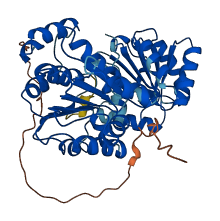
Descriptions
The autoinhibited protein was predicted that may have potential autoinhibitory elements via cis-regPred.
Autoinhibitory domains (AIDs)
Target domain |
|
Relief mechanism |
|
Assay |
cis-regPred |
Accessory elements
No accessory elements
Autoinhibited structure

Activated structure
1 structures for A1CMQ7
| Entry ID | Method | Resolution | Chain | Position | Source |
|---|---|---|---|---|---|
| AF-A1CMQ7-F1 | Predicted | AlphaFoldDB |
No variants for A1CMQ7
| Variant ID(s) | Position | Change | Description | Diseaes Association | Provenance |
|---|---|---|---|---|---|
| No variants for A1CMQ7 | |||||
No associated diseases with A1CMQ7
4 regional properties for A1CMQ7
Functions
| Description | ||
|---|---|---|
| EC Number | 3.6.4.13 | Acting on ATP; involved in cellular and subcellular movement |
| Subcellular Localization |
|
|
| PANTHER Family | ||
| PANTHER Subfamily | ||
| PANTHER Protein Class | ||
| PANTHER Pathway Category | No pathway information available | |
3 GO annotations of cellular component
| Name | Definition |
|---|---|
| chromosome, telomeric region | The end of a linear chromosome, required for the integrity and maintenance of the end. A chromosome telomere usually includes a region of telomerase-encoded repeats the length of which rarely exceeds 20 bp each and that permits the formation of a telomeric loop (T-loop). The telomeric repeat region is usually preceded by a sub-telomeric region that is gene-poor but rich in repetitive elements. Some telomeres only consist of the latter part (for eg. D. melanogaster telomeres). |
| spliceosomal complex | Any of a series of ribonucleoprotein complexes that contain snRNA(s) and small nuclear ribonucleoproteins (snRNPs), and are formed sequentially during the spliceosomal splicing of one or more substrate RNAs, and which also contain the RNA substrate(s) from the initial target RNAs of splicing, the splicing intermediate RNA(s), to the final RNA products. During cis-splicing, the initial target RNA is a single, contiguous RNA transcript, whether mRNA, snoRNA, etc., and the released products are a spliced RNA and an excised intron, generally as a lariat structure. During trans-splicing, there are two initial substrate RNAs, the spliced leader RNA and a pre-mRNA. |
| transcription export complex | The transcription export (TREX) complex couples transcription elongation by RNA polymerase II to mRNA export. The complex associates with the polymerase and travels with it along the length of the transcribed gene. TREX is composed of the THO transcription elongation complex as well as other proteins that couple THO to mRNA export proteins. The TREX complex is known to be found in a wide range of eukaryotes, including S. cerevisiae and metazoans. |
4 GO annotations of molecular function
| Name | Definition |
|---|---|
| ATP binding | Binding to ATP, adenosine 5'-triphosphate, a universally important coenzyme and enzyme regulator. |
| ATP hydrolysis activity | Catalysis of the reaction: ATP + H2O = ADP + H+ phosphate. ATP hydrolysis is used in some reactions as an energy source, for example to catalyze a reaction or drive transport against a concentration gradient. |
| RNA binding | Binding to an RNA molecule or a portion thereof. |
| RNA helicase activity | Unwinding of an RNA helix, driven by ATP hydrolysis. |
6 GO annotations of biological process
| Name | Definition |
|---|---|
| mRNA 3'-end processing | Any process involved in forming the mature 3' end of an mRNA molecule. |
| mRNA export from nucleus | The directed movement of mRNA from the nucleus to the cytoplasm. |
| mRNA splicing, via spliceosome | The joining together of exons from one or more primary transcripts of messenger RNA (mRNA) and the excision of intron sequences, via a spliceosomal mechanism, so that mRNA consisting only of the joined exons is produced. |
| subtelomeric heterochromatin assembly | The compaction of chromatin into heterochromatin at the subtelomeric region. |
| transcription elongation by RNA polymerase II promoter | The extension of an RNA molecule after transcription initiation and promoter clearance at an RNA polymerase II promoter by the addition of ribonucleotides catalyzed by RNA polymerase II. |
| transcription-coupled nucleotide-excision repair | The nucleotide-excision repair process that carries out preferential repair of DNA lesions on the actively transcribed strand of the DNA duplex. In addition, the transcription-coupled nucleotide-excision repair pathway is required for the recognition and repair of a small subset of lesions that are not recognized by the global genome nucleotide excision repair pathway. |
No homologous proteins in AiPD
| UniProt AC | Gene Name | Protein Name | Species | Evidence Code |
|---|---|---|---|---|
| No homologous proteins | ||||
| 10 | 20 | 30 | 40 | 50 | 60 |
| MSHEEDLIDY | SDEELQTTDA | AATTAAPAAN | GAQDKKGDLT | VSGGRPDKKG | SYVGIHSTGF |
| 70 | 80 | 90 | 100 | 110 | 120 |
| RDFLLKGELL | RAITDCGFEH | PSEVQQVCIP | TAILNVDVLC | QAKSGLGKTA | VFVLTTLHQL |
| 130 | 140 | 150 | 160 | 170 | 180 |
| EPVPGECSVL | VMCHTRELAY | QIKNEYARFS | KYLPDVKTAV | FYGGTPIQKD | VEVLSNKESY |
| 190 | 200 | 210 | 220 | 230 | 240 |
| PNIVVGTPGR | LNALVRDKKL | SLRNVKAFVL | DECDKMLDQI | DMRRDVQEIF | RATPADKQVM |
| 250 | 260 | 270 | 280 | 290 | 300 |
| MFSATLSQEI | RPICKKFMRN | PLEVYVDDDT | KLTLHGLQQY | YIKLSESEKN | RKLNELLDSL |
| 310 | 320 | 330 | 340 | 350 | 360 |
| EFNQVIIFVK | STLRANELDK | LLRECNFPSI | AVHSGVSQEE | RIKRYKEFKE | FNKRICVATD |
| 370 | 380 | 390 | 400 | 410 | 420 |
| VFGRGIDIER | INLAINYDLP | ADADSYLHRV | GRAGRFGTKG | LSISFVSNED | DEKVLKEIEK |
| 430 | 440 | ||||
| RFEVALPEYP | EGGVDSSTYM | A |