A1CAZ7
Gene name |
uba4 |
Protein name |
Adenylyltransferase and sulfurtransferase uba4 |
Names |
Common component for nitrate reductase and xanthine dehydrogenase protein F, Ubiquitin-like protein activator 4 |
Species |
Aspergillus clavatus (strain ATCC 1007 / CBS 513.65 / DSM 816 / NCTC 3887 / NRRL 1 / QM 1276 / 107) |
KEGG Pathway |
act:ACLA_013510 |
EC number |
2.7.7.80: Nucleotidyltransferases |
Protein Class |
|
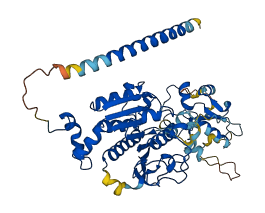
Descriptions
The autoinhibited protein was predicted that may have potential autoinhibitory elements via cis-regPred.
Autoinhibitory domains (AIDs)
Target domain |
|
Relief mechanism |
|
Assay |
cis-regPred |
Accessory elements
No accessory elements
Autoinhibited structure

Activated structure
1 structures for A1CAZ7
| Entry ID | Method | Resolution | Chain | Position | Source |
|---|---|---|---|---|---|
| AF-A1CAZ7-F1 | Predicted | AlphaFoldDB |
No variants for A1CAZ7
| Variant ID(s) | Position | Change | Description | Diseaes Association | Provenance |
|---|---|---|---|---|---|
| No variants for A1CAZ7 | |||||
No associated diseases with A1CAZ7
Functions
| Description | ||
|---|---|---|
| EC Number | 2.7.7.80 | Nucleotidyltransferases |
| Subcellular Localization |
|
|
| PANTHER Family | ||
| PANTHER Subfamily | ||
| PANTHER Protein Class | ||
| PANTHER Pathway Category | No pathway information available | |
1 GO annotations of cellular component
| Name | Definition |
|---|---|
| cytosol | The part of the cytoplasm that does not contain organelles but which does contain other particulate matter, such as protein complexes. |
8 GO annotations of molecular function
| Name | Definition |
|---|---|
| ATP binding | Binding to ATP, adenosine 5'-triphosphate, a universally important coenzyme and enzyme regulator. |
| identical protein binding | Binding to an identical protein or proteins. |
| metal ion binding | Binding to a metal ion. |
| molybdopterin-synthase adenylyltransferase activity | Catalysis of the reaction: ATP |
| molybdopterin-synthase sulfurtransferase activity | Catalysis of the reaction: -Gly-NH-CH(2)-C(O)SH + cysteine desulfurase. |
| protein adenylyltransferase activity | Catalysis of the reaction: ATP + protein = diphosphate + adenylyl-protein; mediates the addition of an adenylyl (adenosine 5'-monophosphate; AMP group) to specific residues of target proteins. |
| thiosulfate sulfurtransferase activity | Catalysis of the reaction: hydrogen cyanide + thiosulfate = H(+) + sulfite + thiocyanate. |
| URM1 activating enzyme activity | Catalysis of the activation of the small ubiquitin-related modifier URM1, through the formation of an ATP-dependent high-energy thiolester bond. |
7 GO annotations of biological process
| Name | Definition |
|---|---|
| cell budding | A form of asexual reproduction, occurring in certain bacteria and fungi (e.g. yeasts) and some primitive animals in which an individual arises from a daughter cell formed by pinching off a part of the parent cell. The budlike outgrowths so formed may sometimes remain attached to the parent cell. |
| cellular response to oxidative stress | Any process that results in a change in state or activity of a cell (in terms of movement, secretion, enzyme production, gene expression, etc.) as a result of oxidative stress, a state often resulting from exposure to high levels of reactive oxygen species, e.g. superoxide anions, hydrogen peroxide (H2O2), and hydroxyl radicals. |
| invasive growth in response to glucose limitation | A growth pattern exhibited by budding haploid cells under certain growth conditions, in which cells retain the typical axial budding pattern of haploids, but become elongated and fail to separate after division; during growth on a solid substrate, this results in penetration of cells into the agar medium. An example of this process is found in Saccharomyces cerevisiae. |
| Mo-molybdopterin cofactor biosynthetic process | The chemical reactions and pathways resulting in the formation of the Mo-molybdopterin cofactor, essential for the catalytic activity of some enzymes. The cofactor consists of a mononuclear molybdenum (Mo) ion coordinated by one or two molybdopterin ligands. |
| protein urmylation | Covalent attachment of the ubiquitin-like protein URM1 to another protein. |
| regulation of pseudohyphal growth | Any process that modulates the frequency, rate or extent of pseudohyphal growth. |
| tRNA wobble position uridine thiolation | The process in which a uridine residue at position 34 in the anticodon of a tRNA is post-transcriptionally thiolated at the C2 position. This process involves transfer of a sulfur from cysteine to position C2 by several steps. |
No homologous proteins in AiPD
| UniProt AC | Gene Name | Protein Name | Species | Evidence Code |
|---|---|---|---|---|
| No homologous proteins | ||||
| 10 | 20 | 30 | 40 | 50 | 60 |
| MENLEQTCAS | LRAQIAATEA | QLAGLKRDLE | VAEQAAAEIK | AQDVKSTGIR | EEGSEKKNPW |
| 70 | 80 | 90 | 100 | 110 | 120 |
| PLLSEEYKRY | GRQMIVPQLG | LQGQLKLRSA | RVLIVGAGGL | GCPAALYLAG | AGVGTLGLVD |
| 130 | 140 | 150 | 160 | 170 | 180 |
| GDTVEHSNLH | RQVLHRSKNV | GKFKVDSAIE | YLRELNPHPT | YVPYRAHLTP | QEAPEIFKDY |
| 190 | 200 | 210 | 220 | 230 | 240 |
| DIVLDCTDNP | ATRYLISDTA | VLLGKPLVSA | SALRTEGQLI | VLNNPPRPVG | DKSGGPCYRC |
| 250 | 260 | 270 | 280 | 290 | 300 |
| VFPKPPPATS | VVSCADGGII | GPVVGTMGVL | QAIEAIKVIT | SSPADETSAS | PPSLLIFSAY |
| 310 | 320 | 330 | 340 | 350 | 360 |
| STPPFRSIKI | RSRRANCAVC | SAEASVTVET | LKTGSTDYVF | FCGVAGPETL | LRPEERITPL |
| 370 | 380 | 390 | 400 | 410 | 420 |
| EFKKKHPGQV | SHEQELGGSK | EPTIIDVREQ | VQFDICSLDN | SINIPISTIL | SSAASPTTST |
| 430 | 440 | 450 | 460 | 470 | 480 |
| PESLPSWLPH | DIVSSSSTDP | IYVVCRLGND | SQIAVRKMKE | LGLDQGGKRF | ICDIQGGLRA |
| 490 | |||||
| WREQIDPDWP | EY |