A0DB19
Gene name |
GSPATT00015130001 |
Protein name |
Lissencephaly-1 homolog 1 |
Names |
|
Species |
Paramecium tetraurelia |
KEGG Pathway |
ptm:GSPATT00015130001 |
EC number |
|
Protein Class |
|
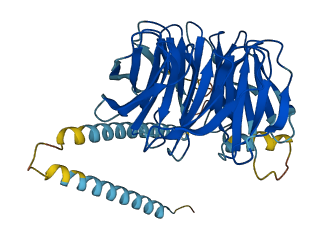
Descriptions
The autoinhibited protein was predicted that may have potential autoinhibitory elements via cis-regPred.
Autoinhibitory domains (AIDs)
Target domain |
|
Relief mechanism |
|
Assay |
cis-regPred |
Accessory elements
No accessory elements
Autoinhibited structure

Activated structure
1 structures for A0DB19
| Entry ID | Method | Resolution | Chain | Position | Source |
|---|---|---|---|---|---|
| AF-A0DB19-F1 | Predicted | AlphaFoldDB |
No variants for A0DB19
| Variant ID(s) | Position | Change | Description | Diseaes Association | Provenance |
|---|---|---|---|---|---|
| No variants for A0DB19 | |||||
No associated diseases with A0DB19
9 regional properties for A0DB19
| Type | Name | Position | InterPro Accession |
|---|---|---|---|
| repeat | WD40 repeat | 94 - 318 | IPR001680-1 |
| repeat | WD40 repeat | 321 - 401 | IPR001680-2 |
| domain | LIS1 homology motif | 7 - 38 | IPR006594 |
| conserved_site | WD40 repeat, conserved site | 162 - 176 | IPR019775-1 |
| conserved_site | WD40 repeat, conserved site | 204 - 218 | IPR019775-2 |
| conserved_site | WD40 repeat, conserved site | 347 - 361 | IPR019775-3 |
| repeat | G-protein beta WD-40 repeat | 120 - 134 | IPR020472-1 |
| repeat | G-protein beta WD-40 repeat | 204 - 218 | IPR020472-2 |
| repeat | G-protein beta WD-40 repeat | 347 - 361 | IPR020472-3 |
Functions
4 GO annotations of cellular component
| Name | Definition |
|---|---|
| cytoplasm | The contents of a cell excluding the plasma membrane and nucleus, but including other subcellular structures. |
| microtubule | Any of the long, generally straight, hollow tubes of internal diameter 12-15 nm and external diameter 24 nm found in a wide variety of eukaryotic cells; each consists (usually) of 13 protofilaments of polymeric tubulin, staggered in such a manner that the tubulin monomers are arranged in a helical pattern on the microtubular surface, and with the alpha/beta axes of the tubulin subunits parallel to the long axis of the tubule; exist in equilibrium with pool of tubulin monomers and can be rapidly assembled or disassembled in response to physiological stimuli; concerned with force generation, e.g. in the spindle. |
| microtubule associated complex | Any multimeric complex connected to a microtubule. |
| microtubule organizing center | An intracellular structure that can catalyze gamma-tubulin-dependent microtubule nucleation and that can anchor microtubules by interacting with their minus ends, plus ends or sides. |
1 GO annotations of molecular function
| Name | Definition |
|---|---|
| dynein complex binding | Binding to a dynein complex, a protein complex that contains two or three dynein heavy chains and several light chains, and has microtubule motor activity. |
3 GO annotations of biological process
| Name | Definition |
|---|---|
| cell division | The process resulting in division and partitioning of components of a cell to form more cells; may or may not be accompanied by the physical separation of a cell into distinct, individually membrane-bounded daughter cells. |
| establishment of mitotic spindle orientation | A cell cycle process that sets the alignment of mitotic spindle relative to other cellular structures. |
| microtubule sliding | The movement of one microtubule along another microtubule. |
No homologous proteins in AiPD
| UniProt AC | Gene Name | Protein Name | Species | Evidence Code |
|---|---|---|---|---|
| No homologous proteins | ||||
| 10 | 20 | 30 | 40 | 50 | 60 |
| MVLTARQRDE | LNQAIHQYLL | ISYQQSAQLF | KTEAAVKDGQ | IEADLLEKKW | NSIVRLSKRV |
| 70 | 80 | 90 | 100 | 110 | 120 |
| ITLEQQVEQL | NEQLAQAQAG | KIQFNKSDDE | QRLTPIEKFK | LEGHRAGVNC | VAFHPQYQIL |
| 130 | 140 | 150 | 160 | 170 | 180 |
| GSASDDGSIK | LWDYESGHFE | KTLKGHTSNV | NCLAFDPTGK | YICSASSDLS | IKIWELKNHT |
| 190 | 200 | 210 | 220 | 230 | 240 |
| CVKTLIGHEH | SVSTVQFSDH | GDFILSASRD | KNIKLWEVAT | GFCKKTFSEH | QEWVRCAVFS |
| 250 | 260 | 270 | 280 | 290 | 300 |
| NDEKQIASCS | QDQMIYIWVI | DSGQVLHQLS | GHEHVVEQVK | YIPEHGAKQI | LTQQQQQNIQ |
| 310 | 320 | 330 | 340 | 350 | 360 |
| TINLLVSVSR | DKEIKIWNTI | LGTNLFTLSG | HDNWVNGVSF | HPDGVHMLSV | SDDKTIRVWN |
| 370 | 380 | 390 | 400 | ||
| LKEQKQKKKI | ENAHDKFILK | CEINKFIFAT | CSVDQTIKLW | LLS |